
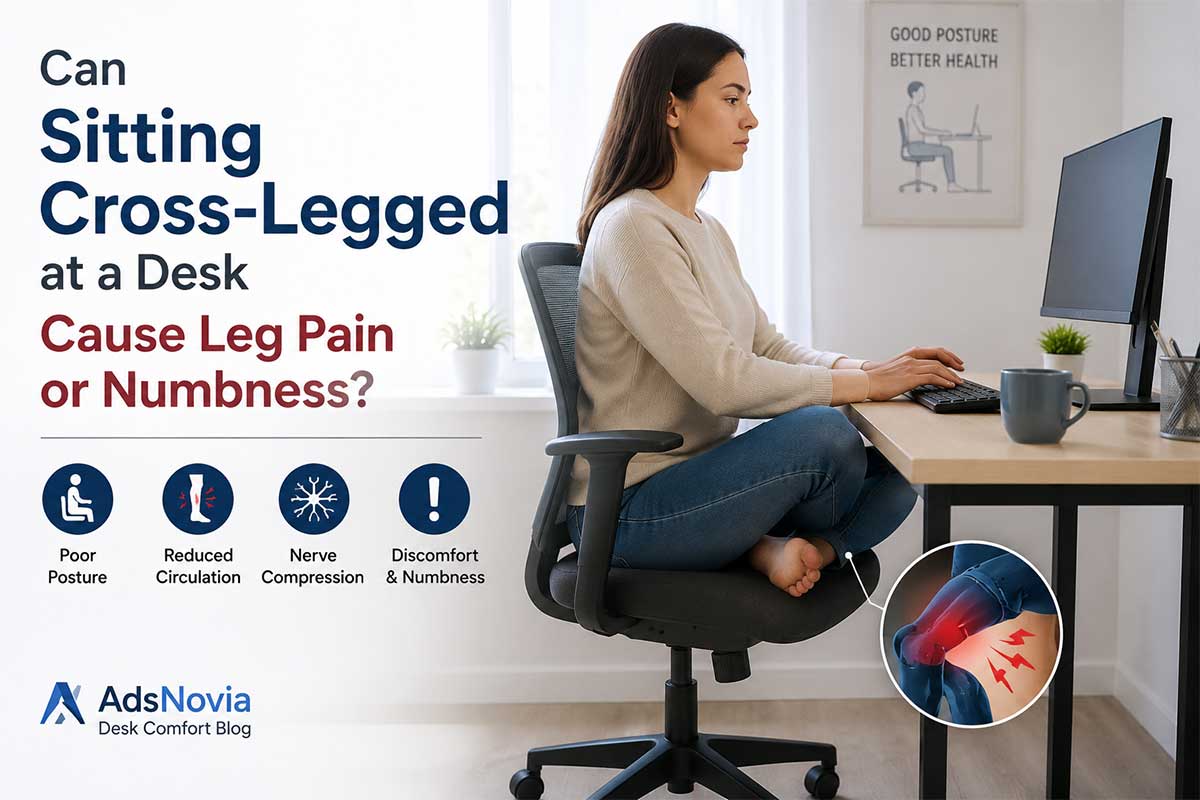
A lot of people settle into a cross-legged position at their desk without giving it much thought. It feels natural, it can even feel more comfortable than a standard sitting posture—at least for the first twenty minutes or so. But the question of whether sitting cross-legged at a desk can cause leg pain or numbness is one that comes up frequently, and the honest answer is more nuanced than a simple yes or no. The short version: it depends on how long you sit that way, how your desk is set up, and whether your body is already dealing with any circulation or posture challenges. This article walks through what’s actually happening when your legs go numb, why some positions cause problems faster than others, and what practical changes you can make to stay more comfortable through a long working day.
Quick Answer
Sitting cross-legged at a desk can cause leg pain or numbness, particularly when maintained for extended periods. The position compresses nerves and blood vessels in the legs and hips, which reduces circulation and may trigger tingling or numbness. Short stretches of cross-legged sitting are generally low-risk for most people, but using it as a default all-day posture—especially without ergonomic support—may contribute to discomfort, poor pelvic alignment, and fatigue over time.
Why People Sit Cross-Legged at a Desk in the First Place
Cross-legged sitting often starts as a comfort habit rather than a deliberate ergonomic choice. For many people, it begins in childhood during school or floor-based activities, making it a posture that feels instinctively familiar even in an office chair.
There’s also a functional reason it happens at desks. When a chair is slightly too high or the desk layout makes the standard seated position feel awkward, people naturally seek an alternative. Tucking one or both legs up provides a sense of grounding—especially when feet can’t comfortably reach the floor. Students working on low coffee tables, remote workers using dining chairs, and gamers sinking into low seats are particularly likely to default to this position.
It’s not entirely without benefit for brief periods. Some people find it temporarily eases lower back tension by tilting the pelvis slightly forward. Others use it as a focus position during deep concentration. The problem arises when a brief habit becomes an hours-long default.
Can Sitting Cross-Legged at a Desk Cause Leg Pain or Numbness?
Yes, it can—and the mechanism behind it is fairly straightforward. When you sit cross-legged in a chair, particularly with both legs folded inward, you create compression points in the hip, knee, and thigh areas. That compression affects two things: blood flow and nerve conduction.
The result is what most people recognize as that tingling, heavy, or “asleep” feeling in the legs. In mild cases it passes quickly once you shift position. In more prolonged cases, the sensation can linger for several minutes and may come with aching or stiffness in the hip and lower back as well.
It’s worth noting that occasional cross-legged sitting at a desk is unlikely to cause lasting harm for most healthy adults. The concern is prolonged or habitual use as the primary sitting posture during long working sessions.
Why Legs Go Numb When You Cross Them While Sitting
The Role of Nerve Compression
The most common culprit behind numbness when sitting cross-legged is the common peroneal nerve, which runs around the outside of the knee. When you cross your legs—either at the knee or in a full cross-legged position—this nerve can become compressed between bone and the edge of the seat or the opposite leg. Pressure on this nerve interferes with its ability to send signals normally, which produces the tingling or numb sensation most people experience.
According to the Cleveland Clinic, nerve compression during sitting is a well-recognized cause of temporary numbness in the legs, and it usually resolves quickly once pressure is removed. However, repeated or sustained compression may take longer to clear and can occasionally cause lingering sensitivity.
The Role of Restricted Blood Flow
Alongside nerve compression, cross-legged sitting can restrict the return of blood from the lower legs back toward the heart. The folded position puts pressure on the blood vessels in the hip and thigh region, slowing circulation. This is why legs can feel heavy or achy in addition to numb—the muscles and tissues aren’t receiving the same steady supply of oxygenated blood they would with the legs in a more open, neutral position.
If you’ve noticed that your legs feel heavy or sluggish after long sitting sessions in general, not just when cross-legged, there’s a broader picture of circulation at play. Our article exploring why legs feel heavy after sitting but improve after walking explains the circulation mechanics behind that pattern in more detail.
How Long Does It Take for Problems to Develop?
This varies significantly between individuals. Some people begin to notice tingling within ten to fifteen minutes of sustained cross-legged sitting. Others can maintain the position for longer without immediate symptoms. Factors that influence this include body weight, individual nerve anatomy, chair firmness, and existing circulation health.
As a general guide, if numbness or tingling develops consistently within fifteen to thirty minutes of cross-legged sitting, the position is likely compressing nerves or vessels enough that it warrants a posture change—not just a brief shift and return to the same position.
Common Sitting Mistakes That Make Things Worse
Cross-legged sitting rarely exists in isolation. It usually combines with other posture habits that compound the strain on the lower body. These are some of the most common patterns that make things harder:
- Staying in the same position for hours without small adjustments or standing breaks
- Sitting cross-legged on a chair that is already too high, which adds extra compression at the hip and knee
- Leaning forward toward the screen while cross-legged, which rounds the lower back and increases spinal load
- Alternating between the same two positions repeatedly instead of genuinely changing the sitting angle
- Assuming that because the position feels comfortable initially, it is ergonomically neutral
- Ignoring mild tingling as harmless rather than treating it as a signal to shift position
One specific mistake worth highlighting is the combination of a chair set too high and a cross-legged position. When the chair seat is elevated, the thighs aren’t properly supported by the seat surface, and folding the legs inward only concentrates more body weight on a smaller contact area. If your chair height is part of the problem, our overview of how desk chair height affects leg comfort and blood flow is a practical starting point for correcting that before looking at other adjustments.
Better Alternatives to Sitting Cross-Legged at a Desk
If cross-legged sitting feels more comfortable than standard seated posture, that’s often a signal that something about the standard setup isn’t working—not that cross-legged is superior. Addressing the underlying setup issue typically reduces the urge to sit cross-legged in the first place.
Feet Flat on the Floor
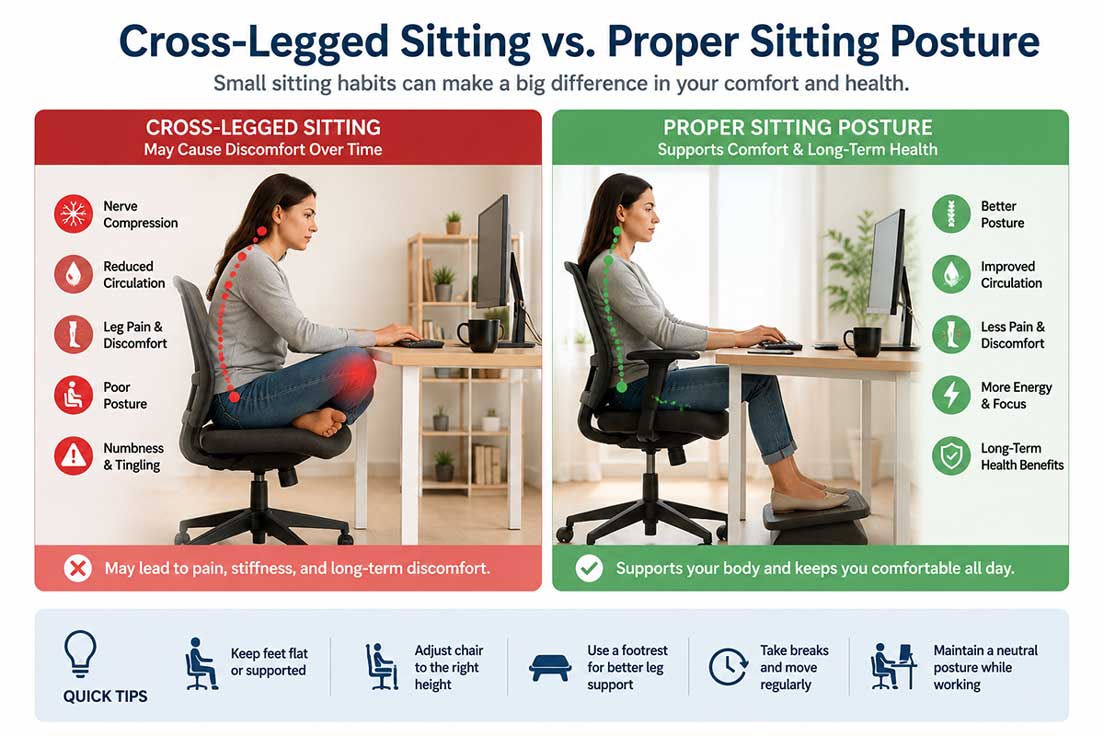
The most widely recommended position for sustained desk work is both feet resting flat on the floor, with knees at approximately a 90-degree angle and thighs parallel to the ground. This distributes body weight evenly across the seat and keeps blood vessels and nerves in a relatively uncompressed position throughout the lower body.
Getting this right requires that your chair height and desk height are compatible. If you’re working toward a more neutral seated posture, our guide on correct sitting position for all-day desk work covers chair, desk, and screen alignment together as part of a complete setup.
Ankles Crossed Rather Than Knees
For those who find a fully open-leg position difficult to sustain, crossing at the ankles rather than the knees is a significantly lower-risk alternative. The pressure on nerves and vessels is much lower when the cross point is below the knee rather than at or above it. It’s still not ideal for all-day use, but it reduces the most problematic compression points.
Alternating Leg Positions Regularly
No single seated position is ideal for eight hours straight. The real ergonomic goal is variation—changing your leg position every thirty to sixty minutes, standing briefly, and taking short walks when possible. Even small shifts, like uncrossing and extending one leg, can meaningfully change the pressure distribution across the hips and thighs.
Using a Footrest to Support a Neutral Position
A common reason people cross their legs at a desk is that their feet don’t comfortably reach the floor. When the feet have nowhere supported to rest, cross-legged sitting fills that gap instinctively. An ergonomic footrest addresses this directly by bringing solid ground up to where the feet naturally want to be. If you’re new to footrests, our introduction to what an ergonomic footrest does and who benefits from one is a clear starting point before looking at specific options.
How an Ergonomic Footrest Can Help
A footrest works by providing a supported surface for the feet when the floor alone doesn’t provide adequate contact at the right chair height. This matters because cross-legged sitting is often a substitute for foot support—people cross their legs to create a resting surface for their lower body when the seat itself isn’t providing it.
By placing feet on a footrest, the thighs rest more fully on the seat surface, the knees stay in a more open and relaxed angle, and the lower back is less likely to compensate through rounding or twisting. The result is a posture where the urge to cross the legs tends to decrease naturally.
Footrests can also help reduce the swelling and fatigue that accumulate in the feet and ankles during long sitting sessions. If you notice your feet swelling toward the end of a workday, our article on why feet swell during prolonged sitting and what helps explains the underlying causes and where a footrest fits into addressing them.
When a Footrest Alone Is Not Enough
It’s worth being direct here: a footrest is a helpful ergonomic tool, not a complete posture solution on its own. If cross-legged sitting is a habit driven by a chair that’s too high, a footrest may solve the immediate problem. But if the habit is driven by other factors—chronic lower back tension, deep-seated posture habits, or discomfort from a poorly designed chair—the footrest addresses one symptom without changing the broader setup.
Similarly, if leg numbness or pain persists even after improving your desk setup and reducing cross-legged sitting, that’s a sign to seek advice from a healthcare professional rather than continuing to adjust equipment. Ergonomic changes are genuinely useful, but they work within limits. For a broader look at how circulation in the legs can be affected by prolonged sitting in general, our article on whether sitting too long can cause poor circulation in the legs covers the topic in detail.
Practical Desk Setup Tips for Better Leg Comfort
- Set your chair height so that your feet rest flat on the floor or on a footrest with your knees at approximately 90 degrees. If this position causes your thighs to slope sharply upward, the chair may be too low. If the thighs slope downward, the chair is likely too high.
- Check the seat depth of your chair. There should be approximately two to three finger widths of space between the back of your knee and the front edge of the seat. A seat that is too deep pushes the edge into the back of the knee and makes alternative leg positions more tempting.
- Set a movement reminder every 30 to 45 minutes. Standing up, walking briefly, or simply shifting your leg position resets the pressure points that build up during static sitting.
- If your feet don’t comfortably reach the floor at a correctly adjusted chair height, add a footrest before experimenting with other solutions. Height-adjustable or tilting footrests tend to offer more flexibility than flat, fixed platforms.
- Assess whether your cross-legged position is related to monitor or keyboard placement. If you’re leaning forward to see the screen, you may be compensating for poor monitor height—and the leaning posture may be what makes standard leg positioning feel uncomfortable.
For those unsure where to start when choosing a footrest, our adjustable footrest buying guide walks through the key features to look for, and our guidance on finding the right footrest height for your specific setup helps match the product to your desk and chair combination.
Sitting Position Comparison: Comfort vs. Risk
| Sitting Position | Common Problems | Best For |
|---|---|---|
| Cross-legged on chair | Nerve pressure, restricted blood flow, knee strain | Short breaks only — not sustained desk work |
| Feet flat on floor | Minimal if chair height is correct | All-day desk work |
| Feet on footrest | Minimal — supports neutral posture | When feet don’t comfortably reach the floor |
| Legs crossed at ankle | Low risk when changed regularly | Those who prefer some cross-leg contact |
| One foot tucked under | Uneven hip load, potential spine imbalance | Very brief position changes only |
Common Myths About Sitting Cross-Legged at a Desk
Myth: Cross-Legged Sitting Is Always Bad for You
The position itself is not inherently harmful. Many traditional cultures use floor-based cross-legged sitting as a default resting posture with no adverse effects. The issue at a desk is duration and context—sitting cross-legged in an office chair for six hours while hunching forward toward a screen is very different from sitting cross-legged briefly during a meditation session or conversation.
Myth: If It Feels Comfortable, It Must Be Fine
Comfort and ergonomic safety are not the same thing. A position can feel comfortable for the first thirty minutes and cause meaningful strain over two hours. The body is good at adapting in the short term and good at accumulating tension over longer periods without obvious signals until a threshold is crossed. Mild tingling, stiffness when standing up, or a heavy feeling in the legs are all signals worth acting on, even when the position felt fine when you settled into it.
Myth: Leg Numbness While Sitting Is Always a Medical Problem
Transient leg numbness from sitting in a compressed position is common and is almost always positional. It resolves quickly once you stand or shift position. Persistent numbness that doesn’t clear when you move, or numbness that appears without any sustained sitting, is a different matter and is worth discussing with a healthcare professional. Position-related numbness and neurological or vascular numbness feel different and behave differently—the former clears with movement, the latter does not.
Myth: A Good Chair Prevents All Leg Problems from Sitting
Even a well-designed ergonomic chair doesn’t fully compensate for staying in the same position for hours without moving. Chair quality affects how well your body is supported within a given posture—but sustained static sitting in any posture still reduces circulation and increases muscle fatigue over time. Our article on how to reduce leg fatigue during long sitting sessions at a desk covers the movement and habit side of leg comfort, which complements any equipment upgrade.
Frequently Asked Questions
Can sitting cross-legged at a desk cause leg pain or numbness in the long term?
Habitual, prolonged cross-legged sitting may contribute to recurring leg discomfort, particularly if it consistently compresses nerves or restricts circulation. For most healthy adults, occasional cross-legged sitting is unlikely to cause lasting problems. The risk increases when the habit is maintained for hours daily without variation or movement breaks.
How long is it safe to sit cross-legged at a desk?
There’s no universal rule, but if you notice tingling or numbness developing, that’s a practical signal to shift position. As a general guide, any sitting position—including standard seated posture—benefits from a movement break every 30 to 45 minutes.
Why do my legs go numb faster in some chairs than others?
Chair seat firmness, seat depth, and seat edge design all influence how quickly pressure builds up against the nerves and blood vessels in the thighs and knees. A firmer seat with a pronounced front edge concentrates pressure more quickly than a seat with a waterfall edge or greater cushioning.
Is crossing legs at the ankle safer than crossing at the knee?
Generally yes. Crossing at the ankle puts much less pressure on the nerves around the knee and creates less restriction of blood flow in the upper leg. It’s still worth alternating positions regularly, but it’s a lower-risk alternative for those who find fully open leg positioning uncomfortable.
Can a footrest help if I sit cross-legged because my feet don’t reach the floor?
Yes, this is one of the most direct use cases for an ergonomic footrest. If your feet dangle or only partially touch the floor, providing a stable surface at the right height often removes the need for cross-legged sitting altogether. The broader benefits of using a footrest at your desk go beyond just solving this one issue, but addressing foot support is a strong starting point.
Why does my hip ache after sitting cross-legged for a long time?
Cross-legged sitting in a chair externally rotates the hip joint and holds it in that rotated position for an extended period. The muscles and connective tissue around the hip, particularly the piriformis and hip flexors, can become fatigued or tight from being held in that angle without movement.
Is sitting cross-legged worse for shorter people?
It can be, because shorter people are more likely to have feet that don’t comfortably reach the floor in standard office chairs, which creates the original motivation for cross-legged sitting. Addressing the chair and footrest setup is particularly important for shorter individuals. Our guide on under-desk footrests designed for people with shorter legs covers specific solutions for this situation.
Should I see a doctor about leg numbness from sitting?
If numbness resolves quickly when you stand and change position, it’s most likely positional and can often be addressed through the ergonomic adjustments described in this article. If numbness is persistent, worsens over time, appears without any sustained sitting, or is accompanied by pain, weakness, or swelling, it’s worth discussing with a healthcare professional to rule out other contributing factors.
Can sitting cross-legged make sciatica worse?
Cross-legged sitting may increase pressure on the sciatic nerve for some people, particularly if the piriformis muscle is already contributing to sciatica symptoms. If you’re managing sciatica and find that cross-legged sitting increases symptoms, it’s worth avoiding the position and reviewing your overall setup. Our article on under-desk footrests for sciatica relief discusses how footrest support can factor into a more comfortable setup for those with sciatic discomfort.
Key Takeaways
- Sitting cross-legged at a desk can cause leg pain or numbness, primarily through nerve compression and restricted circulation
- Short periods of cross-legged sitting are generally low risk; the concern is prolonged or habitual use without movement breaks
- If feet don’t comfortably reach the floor, cross-legged sitting often fills that gap—a footrest addresses the root cause more effectively
- Ankles crossed rather than knees is a lower-risk alternative for those who find fully open leg positioning difficult to sustain
- A footrest helps, but it works best alongside correct chair height, seat depth adjustment, and regular movement habits
- Persistent numbness that doesn’t resolve when changing position is worth discussing with a healthcare professional
Final Thoughts
Sitting cross-legged at a desk is a natural habit for many people, and it doesn’t automatically signal a problem. But when it becomes a default all-day posture—especially in a chair and desk setup that isn’t matched to your body—it can contribute to the leg pain and numbness that many remote workers, students, and office professionals experience without clearly understanding why. The good news is that these are largely positional problems with practical solutions: better chair and footrest adjustment, regular position changes, and awareness of when the body is signaling that it needs a break.
The Mayo Clinic notes that prolonged static sitting in any posture is associated with reduced circulation and increased musculoskeletal discomfort—which is why movement habits matter alongside equipment choices. Small, consistent changes to how you sit and how often you shift position tend to accumulate into meaningful improvements in daily comfort. If discomfort persists even after adjusting your setup, a healthcare professional is the right next step rather than continuing to experiment with equipment alone. For those looking to take a more structured approach to leg comfort at the desk, our guide on preventing leg numbness during long sitting sessions is a practical companion to the advice in this article, covering both setup and movement strategies in detail.