
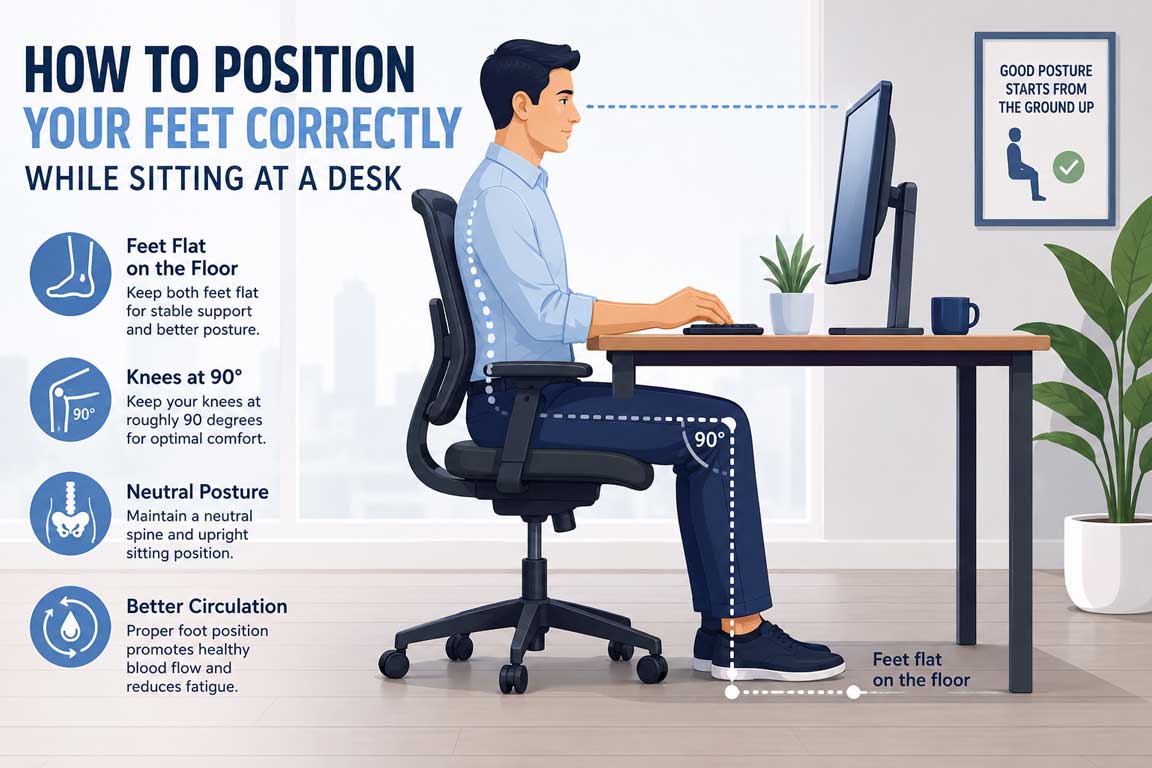
Many office workers focus on monitor height, chair support, or keyboard position when setting up their workspace. But one area that often gets overlooked is foot placement. Knowing how to position your feet correctly while sitting at a desk can have a real impact on your comfort, posture, and how your body feels after a long day. Poor foot placement leads to pressure under the thighs, restricted blood flow, and added strain on the lower back. The good news is that making a few small adjustments can lead to noticeable improvements throughout the workday.
Quick Answer
Keep both feet flat on the floor with your knees bent at roughly 90 degrees and your thighs parallel to the ground. Your feet should rest directly beneath or slightly in front of your knees. If your feet do not reach the floor comfortably, use an ergonomic footrest to provide stable support and maintain proper alignment throughout the day.
Correct vs Incorrect Foot Placement While Sitting
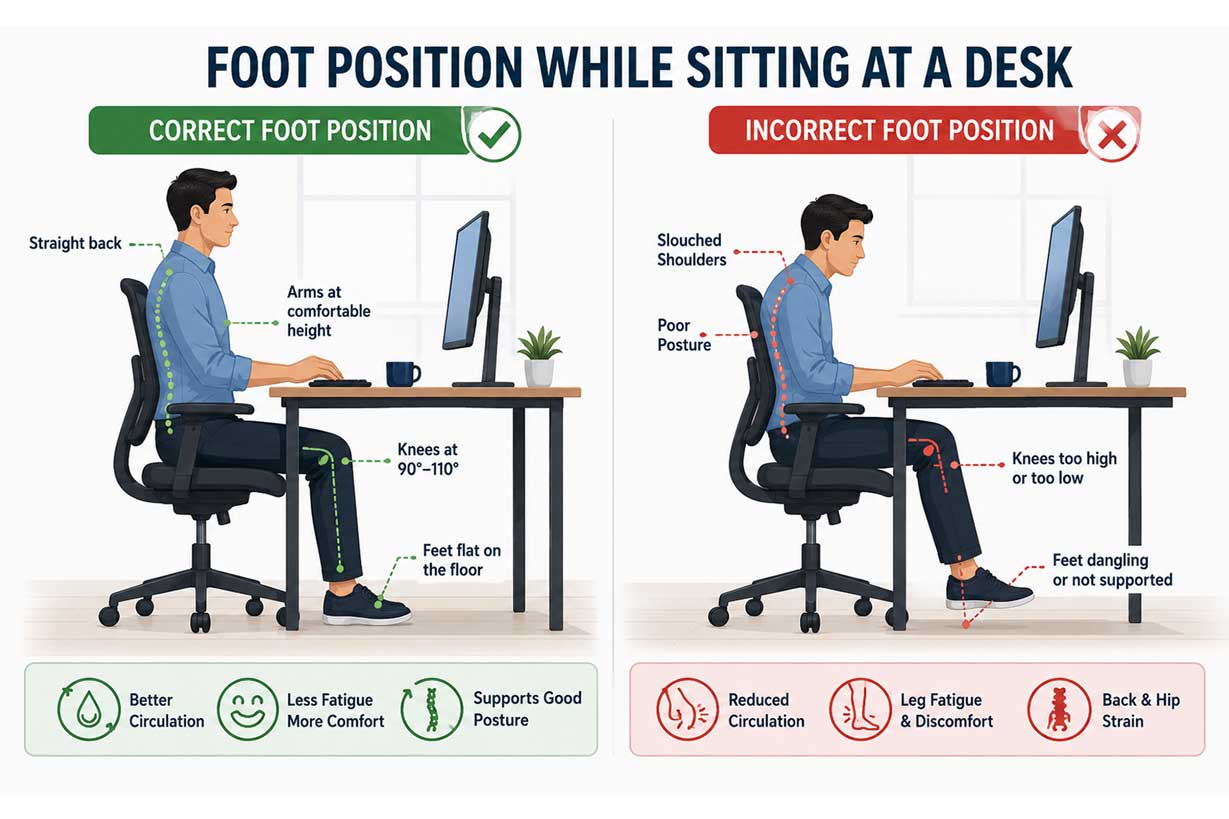
The table below shows how proper and improper foot positions compare across the key factors that affect daily sitting comfort.
| Factor | Correct Foot Position | Incorrect Foot Position |
| Circulation | Promotes healthy blood flow to legs and feet | Restricts blood flow; increases risk of swelling |
| Comfort | Feels natural; reduces pressure points | Creates pressure under thighs; causes discomfort |
| Leg Fatigue | Muscles stay relaxed with proper support | Muscles work harder to compensate; fatigue builds |
| Posture | Supports neutral spine and pelvis alignment | Tilts pelvis; strains lower back and hips |
| Knee Position | Knees at roughly 90 degrees; no extra pressure | Knees above or below hips; joint strain increases |
| Long-Term Comfort | Sustainable for hours with fewer symptoms | Leads to heavy legs, numbness, and poor posture over time |
Why Foot Position Matters During Desk Work
Your feet do more than just rest on the floor while you sit. They act as the base of your entire posture chain. When foot placement is off, it changes the angle of your knees, tilts your pelvis, and shifts pressure along your spine.
Research from OSHA’s ergonomics guidelines emphasizes that the feet, knees, and hips should all form roughly 90-degree angles when seated. This position distributes body weight evenly and reduces strain on the joints. When this alignment breaks down, workers often experience leg fatigue while sitting and lower back discomfort much earlier in the day.
Good foot placement also affects how well you breathe, how focused you feel, and how long you can work without needing to take a break. It is a small change with a meaningful return.
How Foot Placement Affects Circulation and Comfort
The position of your feet directly influences how blood moves through your lower body. When your legs are poorly supported, veins and arteries can become compressed, which slows circulation and causes discomfort over time.
Feet Flat on the Floor
When your feet rest flat on the floor, your thighs remain roughly parallel to the ground. This removes pressure from the underside of your thighs and allows blood to circulate freely down to your feet. The Mayo Clinic notes that sitting for long periods without movement can already slow circulation, so keeping your feet properly supported helps reduce this effect.
This position also makes it easier to maintain a correct sitting posture throughout your desk work, since your lower body forms a stable and balanced foundation.
Feet Dangling Above the Floor
If your chair is set too high and your feet hang without support, the edge of the seat digs into the underside of your thighs. This compresses blood vessels and nerves, reducing circulation to the lower legs and feet.
Over time, this leads to tingling, leg numbness while sitting, and a feeling of heaviness that makes it difficult to concentrate. This is one of the most common foot placement mistakes among office workers.
Crossing Your Legs for Long Periods
Crossing your legs feels comfortable in the short term, but it creates uneven pressure on the hips and knees. It also reduces blood flow to the lower leg that is resting on top. The Cleveland Clinic advises avoiding sustained leg crossing during seated work, as it contributes to poor alignment and increased discomfort over a long workday.
Common Foot Position Mistakes Desk Workers Make
Even workers who invest in good chairs often fall into habits that undermine their posture and comfort. Here are the most frequent mistakes to watch for:
- Tucking feet under the chair, which forces the ankles into an unnatural angle and tightens the calf muscles
- Sitting with feet crossed at the ankles for extended periods, which creates hip imbalance
- Resting on the balls of the feet with heels raised, which increases tension in the calves and lower legs
- Allowing feet to slide out in front of the body, causing the lower back to lose its natural curve
- Ignoring chair height, which is often the root cause of poor foot placement
- Sitting without any foot support when the desk or chair is too tall for the user’s height
Most of these habits develop gradually and go unnoticed until discomfort sets in. Checking your foot position a few times a day can help you catch and correct them before they become a problem.
How to Position Your Feet Correctly While Sitting at a Desk
Getting proper foot placement right does not require expensive equipment. It starts with a few basic principles that work for most seated workstations.
Keep Both Feet Supported
Both feet should be in contact with a surface at all times, whether that is the floor or a footrest. Leaving one foot unsupported while the other rests creates asymmetry in the hips and spine, which can lead to muscle tension on one side of the body.
Make sure the entire sole of each foot rests on the surface. Avoid resting only on the heel or the ball of the foot for extended periods.
Maintain a Comfortable Knee Angle
Your knees should form an angle between 90 and 110 degrees. A 90-degree angle is the traditional recommendation, but a slightly more open angle of around 100 to 110 degrees can feel even more natural for many people. This is one reason why desk chair height and circulation are so closely related. A chair that is too high forces the knees into a sharper angle, while a chair that is too low does the opposite.
Adjust your chair height until your knees and hips sit at roughly the same level and your feet rest comfortably on the surface below.
Align Your Feet With Your Hips
Your feet should be positioned roughly shoulder-width apart, aligned with your hips. Pointing your toes outward or inward for long periods shifts the alignment of the knees and hips, adding unnecessary strain to the joints.
Think of your feet as two parallel lines pointing forward. This neutral alignment supports the natural rotation of your hips and keeps the entire lower body in balance.
Avoid Constant Leg Crossing
Crossing your legs occasionally is not a major concern. The problem arises when it becomes your default sitting position for hours at a time. Set a reminder to uncross your legs regularly and return both feet to a flat, supported position.
If you find yourself crossing your legs because it feels more comfortable than sitting flat, it may be a sign that your chair height or seat depth needs adjustment.
When Should You Use an Ergonomic Footrest?
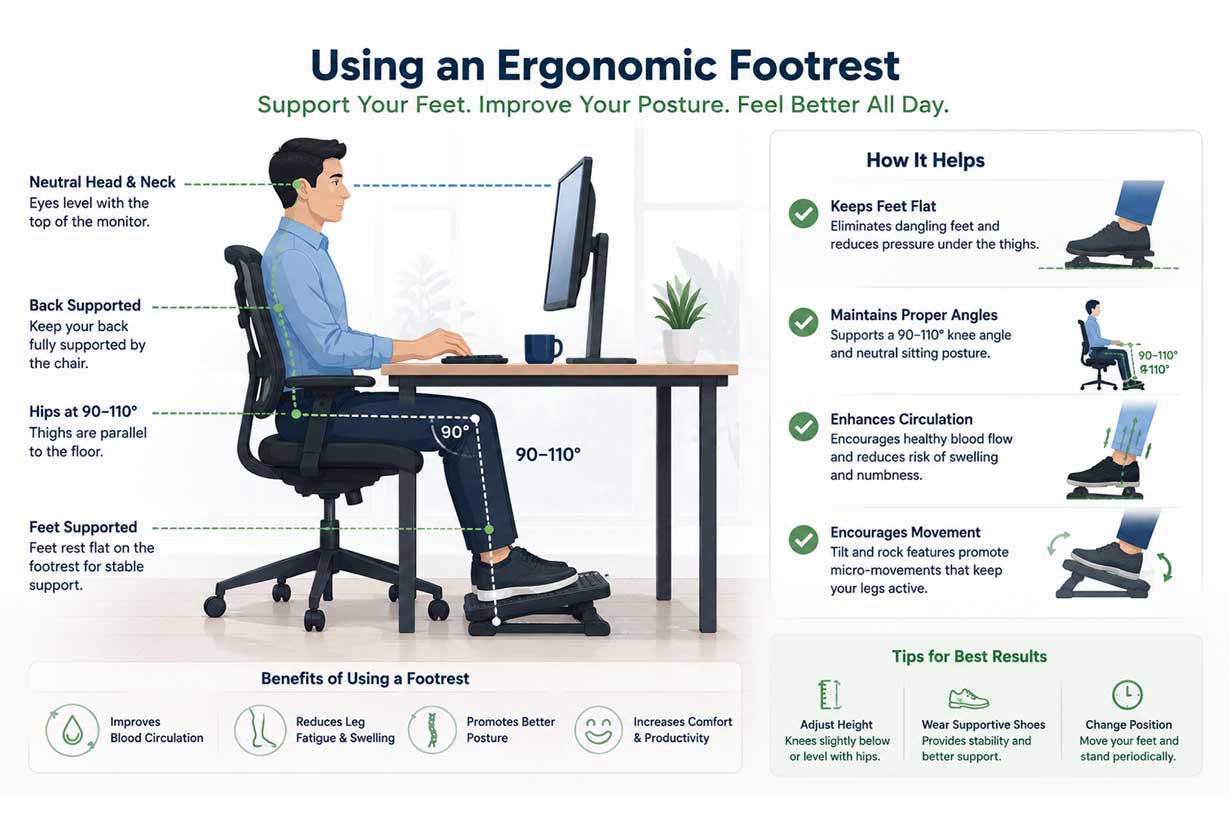
A footrest is not just for people with short legs. Many desk setups create a mismatch between the chair height needed for the keyboard or monitor and the height that allows feet to rest flat on the floor. In these cases, using an ergonomic footrest is the most practical solution.
You may benefit from a footrest if:
- Your feet dangle when you sit at a comfortable working height
- Your desk cannot be adjusted lower to match your chair
- You experience leg fatigue, swelling, or numbness regularly
- You are shorter in stature and standard office furniture does not fit your proportions
- You work long hours and need additional support to stay comfortable
Footrests also promote gentle movement, since many models tilt and rock slightly. This subtle motion encourages micro-circulation and helps prevent the blood from pooling in the lower legs. Research supports the idea that footrests can improve blood circulation while sitting, making them a worthwhile addition for many workers.
The Relationship Between Foot Position, Leg Fatigue, and Heavy Legs
If you regularly feel that your legs are tired, achy, or heavy after a day at your desk, foot position is often part of the problem. When feet are poorly supported, the muscles of the calves and thighs work harder to stabilize the lower body. This continuous low-level effort leads to muscle fatigue that builds throughout the day.
Poor circulation compounds the issue. Blood that cannot move freely tends to pool in the lower legs, causing the heavy, swollen feeling that many desk workers notice by late afternoon. Learning how to relieve heavy legs after sitting all day often starts with correcting the sitting position itself.
Numbness is another common symptom. It usually occurs when sustained pressure on a nerve or blood vessel cuts off sensation to part of the leg or foot. Adjusting your foot position and taking short movement breaks can relieve this quickly.
In some cases, foot swelling at the end of the day points to a more systemic circulation issue. If swelling is persistent, a healthcare provider can rule out any underlying causes. However, for most healthy adults, better foot placement and regular movement are effective first steps.
Additional Desk Ergonomics Tips
Foot placement works best as part of a broader ergonomic setup. Here are a few other adjustments that work alongside proper foot positioning to improve your overall sitting comfort.
Set Your Chair Height Correctly
Chair height is the single most important factor in achieving good foot placement. Adjust your seat so your feet rest flat on the floor or a footrest, your thighs are roughly parallel to the ground, and your knees are at or just below hip level.
Position Your Monitor at Eye Level
A monitor that sits too low causes you to hunch forward, which changes the angle of your entire seated posture, including how your feet rest. The top of your monitor should be at or just slightly below eye level when you are sitting upright.
Take Regular Movement Breaks
No sitting position, however perfect, should be maintained without breaks. Standing up, walking a few steps, or doing light stretches every 30 to 60 minutes keeps blood flowing and reduces muscle fatigue. Set a timer if needed.
Stretch Your Calves and Ankles
Simple stretches done at your desk can relieve tension in the lower legs. Try rotating your ankles in circles, pointing and flexing your feet, or pressing your heels down while lifting your toes. These movements take less than a minute and can significantly reduce the buildup of tightness over a long day.
Check Your Overall Sitting Posture
Foot position and sitting posture are deeply connected. If your lower back loses its natural curve, your hips roll back, which pulls your feet out of position. Keep your back upright, shoulders relaxed, and core lightly engaged to maintain the posture that supports good foot placement throughout the day.
Frequently Asked Questions
Should your feet be flat on the floor when sitting?
Yes. Keeping your feet flat on the floor is the recommended position for most seated desk workers. It supports healthy blood circulation, keeps your thighs parallel to the ground, and helps maintain a neutral spine. If your feet do not reach the floor comfortably, a footrest provides the same benefits.
Is it bad to cross your legs while working?
Occasional leg crossing is not harmful. However, crossing your legs for extended periods each day can create imbalances in the hips and pelvis, compress blood vessels in the upper leg, and contribute to poor sitting posture. Try to alternate positions and return both feet to a flat surface regularly.
Does foot position affect circulation?
Yes, directly. When feet are unsupported or positioned in ways that compress the underside of the thighs, blood flow to the lower legs slows. This can cause swelling, numbness, and a heavy feeling in the legs by the end of the day. Correct foot placement keeps veins and arteries from being compressed.
Can a footrest improve sitting comfort?
A footrest can make a significant difference for workers whose feet do not naturally reach the floor at a comfortable working height. It provides stable support, promotes better posture, and some models encourage gentle foot movement that supports circulation. Learn more about the benefits of an ergonomic footrest for everyday desk use.
How does foot position affect leg fatigue?
When feet are poorly supported, the muscles of the calves and thighs constantly work to stabilize the lower body. This leads to muscle fatigue that builds over the course of a day. Proper foot support removes this unnecessary effort, helping your legs stay comfortable for longer.
What is the ideal foot position for desk work?
The ideal position places both feet flat on a surface, knees at roughly 90 to 110 degrees, and feet hip-width apart with toes pointing forward. Your thighs should be roughly parallel to the floor and free from pressure at the underside. This is the core of how to position your feet correctly while sitting at a desk.
What if my chair is too high and I cannot lower it?
If your chair cannot be adjusted to allow your feet to rest flat, an ergonomic footrest is the best solution. It brings the floor up to meet your feet so you can maintain the correct position without compromising your working height or posture.
Why do my legs feel heavy after sitting all day?
Heavy legs after prolonged sitting are often caused by reduced circulation in the lower limbs. Sitting with feet unsupported or in poor positions compresses blood vessels and slows blood flow. Combined with a lack of movement, this causes blood to pool in the lower legs. Improving your foot position and taking regular standing breaks are effective first steps. See our guide on relieving heavy legs after sitting all day for more strategies.
Conclusion
Foot placement may seem like a minor detail in the bigger picture of desk ergonomics, but its effects are felt throughout the entire body. Knowing how to position your feet correctly while sitting at a desk can reduce leg fatigue, improve circulation, and help you maintain better posture from the ground up.
Start by checking your chair height and making sure both feet rest flat on a supported surface. If that is not possible with your current setup, an ergonomic footrest is a simple and affordable fix. Combine good foot placement with regular movement breaks and attention to overall posture, and your workday will feel noticeably more comfortable over time. Small adjustments made consistently add up. Your legs, back, and overall comfort will benefit from the effort.
1 thought on “How to Position Your Feet Correctly While Sitting at a Desk”