
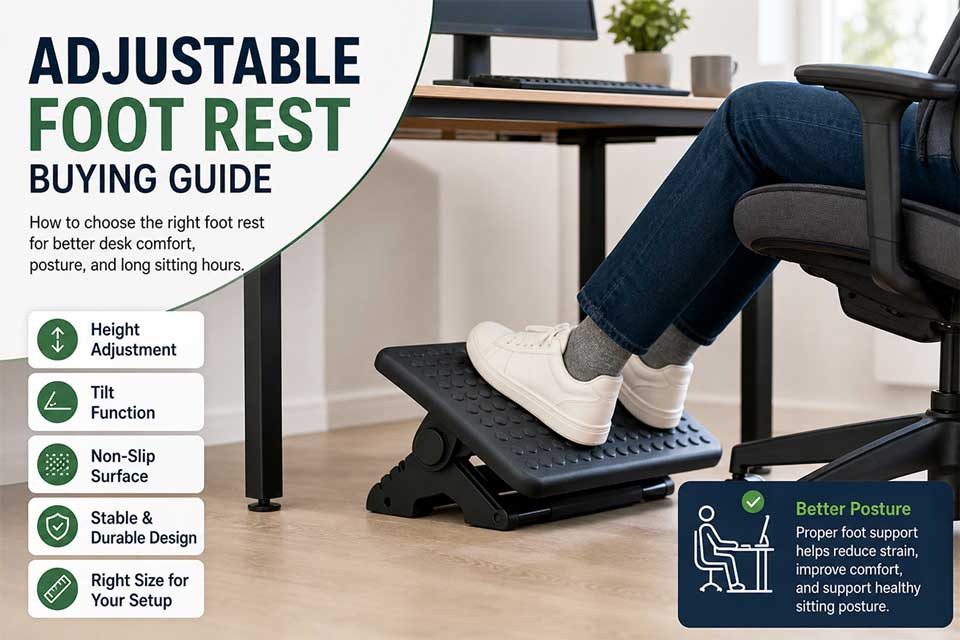
This adjustable foot rest buying guide explains how to choose the right footrest for better desk comfort, posture support, and long sitting hours. Sitting at a desk for hours takes a toll on your body – legs feel heavy, your lower back starts to ache, and no amount of shifting really fixes it.
It supports your legs, takes pressure off your lower back, and lets you settle into a more natural sitting position. But not every footrest works the same way, and picking the wrong one can leave you just as uncomfortable as before.
This guide covers everything you need to know – whether you work in a corporate office or from home.
Quick Answer:
An adjustable footrest is the best choice for most people because it allows you to customize the height and angle for better leg support and overall desk comfort. It’s especially helpful if your chair or desk height cannot be adjusted perfectly or if multiple people share the same workstation.
What Is an Adjustable Foot Rest?
A foot rest is a raised platform that gives your feet somewhere to rest when they do not comfortably reach the floor. A regular fixed footrest holds one set position – no changes, no flexibility.
An adjustable foot rest goes further. You can change the height, the tilt angle, or both, to find the position that works best for your specific chair and desk setup. That flexibility is what makes it useful for a wider range of people.
Think of it this way: a fixed footrest works for one body type and one chair height. An adjustable footrest works for you, whatever your setup looks like.
Why Adjustable Footrests Matter for Desk Comfort
When you sit at a desk, your feet should ideally rest flat on a surface – either the floor or a footrest. When they hang in the air or sit at an awkward angle, it strains the backs of your thighs and shifts pressure onto your lower spine.
Here is how an ergonomic adjustable footrest helps:
- Height support: If your chair height is correct for your desk, your feet may not reach the floor. A footrest fills that gap.
- Leg positioning: Keeping your knees at roughly 90 degrees helps circulation and reduces muscle tension – without needing to lower your chair to an awkward height.
- Natural movement: Some footrests allow a slight rocking or tilting motion, encouraging small shifts throughout the day. Sitting completely still for hours is harder on the body than gentle occasional movement.
- Better sitting posture overall: When your feet are supported, your hips stay level, your back naturally straightens, and your shoulders relax.
According to OSHA ergonomic recommendations, proper lower-body support can help improve sitting comfort during long desk hours.
Key Features to Look For in an Adjustable Foot Rest
Height Adjustment
This is the most important feature. The right height for one person can be completely wrong for another – it all depends on your chair height, desk height, and leg length.
Look for a footrest with at least two or three height settings. Some models use a lever or dial; others have fixed positions that click into place. Either works, as long as the range covers what you need.
As a rough guide, most people need a footrest somewhere between 10 cm and 15 cm off the ground – but always measure your own gap before buying.
Tilt Function
A tiltable surface lets you angle the footrest up or down, keeping your feet in a more natural, relaxed position. Some tilt freely (a slight rocking motion), while others lock into fixed angles.
A gentle forward tilt – where the front sits slightly lower than the back – mimics a natural foot position and tends to feel more comfortable during long sessions than a completely flat surface. If you shift around a lot, a rocker-style footrest helps keep you moving without needing to stand up.
Surface Texture
The surface your feet rest on matters more than you might expect. A smooth, hard surface causes feet to slide – which gets old quickly. A textured or non-slip surface keeps feet steady and can provide a gentle massage effect through the day.
Look for ribbed, bumped, or fabric-covered surfaces made from materials like foam, rubber, or carpet-like material. These feel better, especially if you work without shoes.
Stability and Non-Slip Base
A footrest that slides across the floor whenever you shift is more frustrating than helpful. The underside should have rubber feet, anti-slip pads, or a grippy base that stays put on both hard floors and carpet.
Check whether the non-slip base suits your floor type before buying. Some grip better on hard floors; others hold better on carpet. A few models include adjustable rubber feet that work on both.
Size and Width
A footrest that is too narrow will not give both feet enough room, especially if you shift your feet sideways throughout the day.
A width of around 40–45 cm (16–18 inches) works for most users. If you have a wider stance or larger feet, go for the bigger end of that range. The depth (front to back) also matters if you like to stretch your legs forward while seated.
Material and Build Quality
Footrests are made from several materials, each with its own trade-offs:
- Plastic: Lightweight, easy to clean, and durable for daily use. The most common material for adjustable footrests.
- Foam or cushioned tops: Softer underfoot and more comfortable for long hours, though they may compress over time.
- Wood or bamboo: Sturdy and looks great, but usually heavier and less common in adjustable models.
- Metal frames: Very durable, often found in heavier-duty office footrests.
For most home or office users, a well-made plastic frame with a textured or cushioned surface is the most practical choice – comfortable, durable, and affordable.
Who Should Use an Adjustable Foot Rest?
Not everyone needs a footrest, but certain groups find them especially useful:
- Shorter users: If your feet do not reach the floor comfortably at the right chair height, a footrest is close to essential.
- Office workers and remote workers: Anyone sitting several hours a day can benefit from better foot and leg support.
- People with high chairs or high desks: A taller work surface means a higher chair height, which often means feet lose contact with the floor.
- Anyone with leg discomfort during long sit sessions: Numb feet, tired legs, or a strained lower back after sitting for a while are all signs a footrest may help.
- Older adults: Keeping feet well-supported throughout the day can make a real difference in comfort, especially during longer sitting periods.
A footrest is also useful for anyone who constantly crosses their legs or sits on one foot — habits that usually mean the body is searching for support it is not getting from the floor.
Office vs Home Use: What to Consider
The right footrest for a corporate office and for a home setup can differ in a few practical ways.
In an office setting, you want something that looks reasonably tidy, takes up minimal space, and holds up to five-days-a-week use. Easy positioning and a stable base matter most.
For a home office, you have more flexibility. A softer surface works well if you like to work without shoes, and you can go larger if desk space allows. Style matters less than personal comfort.
Either way, the core priorities are the same: height adjustability, stability, and the right fit for your desk and chair.
Common Buying Mistakes to Avoid
- Choosing the wrong height range. Measure your foot-to-floor gap before buying. Make sure the footrest’s height range actually covers your measurement.
- Ignoring stability. A footrest that slides whenever you shift is a constant annoyance. Always check for proper non-slip features.
- Buying too small. A narrow footrest forces you to keep your feet close together all day. Give yourself enough width to sit naturally.
- Choosing style over comfort. A sleek footrest with a hard, slippery surface will end up under your desk unused. Comfort and function come first.
- Ignoring your overall desk setup. A footrest works best as part of a well-configured desk and chair arrangement. If your chair or desk height is way off, no footrest will fully fix it.
Are Adjustable Footrests Worth It?
For the right person and setup, yes – genuinely worth it.
If your feet do not rest flat on the floor when you are seated at your desk, a footrest removes a real source of discomfort. It supports your legs, helps your hips stay level, and reduces the restlessness that comes from having nowhere to plant your feet.
That said, a footrest is not a fix-all. If your chair is poorly designed or your desk is the wrong height, a footrest alone will not solve everything. It works best as part of a well-thought-out desk setup.
If you already sit comfortably with your feet flat on the floor, you probably do not need one. But for many desk workers – especially shorter individuals or those with higher chairs – it is a straightforward, affordable upgrade.
How to Choose the Right Adjustable Foot Rest: Quick Checklist
Run through this before you buy:
- Measure first. Sit in your usual working position and measure the gap from your feet to the floor.
- Check the height range. Make sure the footrest reaches your required height – ideally with a little room above and below.
- Look for tilt options. A tiltable surface adds comfort for long sitting sessions.
- Check the base. Rubber feet or anti-slip pads suited to your floor type are a must.
- Consider size. Make sure the width gives both feet comfortable room (40–45 cm for most people).
- Check the surface. A textured or cushioned top is more comfortable than a smooth hard surface.
- Think about material. Plastic is practical; foam tops add comfort; heavier materials add durability.
- Read real user reviews. Feedback from people with a similar setup to yours is worth more than specs alone.
Frequently Asked Questions
What height should an adjustable foot rest be?
The right height depends entirely on your setup. Seated in your normal working position, your feet should rest flat on the footrest surface with your knees at roughly 90 degrees. Measure the gap between your feet and the floor before buying, and choose a footrest whose height range covers that measurement.
Is an adjustable foot rest better than a fixed one?
In most cases, yes. A fixed footrest only works well for one specific body size and chair height. An adjustable model can be tuned to match your measurements, making it a better fit for more people – especially if you share a desk or change your chair height regularly.
Can a footrest improve sitting comfort?
A footrest can noticeably improve comfort for people whose feet do not rest flat on the floor in their normal working position. It supports the legs, helps keep the hips level, and reduces the strain from poorly supported feet. Results will vary depending on your existing setup and posture habits.
Should my feet be flat on a footrest?
Generally, yes. Resting your feet flat on the surface distributes weight evenly and keeps your legs in a relaxed position. A slight tilt is fine, as long as your feet feel stable and supported – resting only on your toes or heels is less comfortable over time.
Is a footrest useful for a home office?
Yes, especially if you work from home for long hours. Home office chairs and desks come in all shapes and heights, so many remote workers end up in less-than-ideal setups. An adjustable footrest is an affordable way to improve comfort without replacing your furniture.
Final Thoughts
Choosing an adjustable foot rest does not need to be complicated. Measure the gap your feet need to fill, look for a height range that covers it, check that the base is stable, and make sure the surface is comfortable for the hours you plan to use it.
The best footrest is not the most expensive or the best-looking one. It is the one that fits your desk, your chair, and your body – and stays where you put it. A good desk setup is built piece by piece. An adjustable foot rest is a small but genuinely useful piece of that puzzle.
You can also explore our ergonomic tips category for more desk comfort and posture guides.