
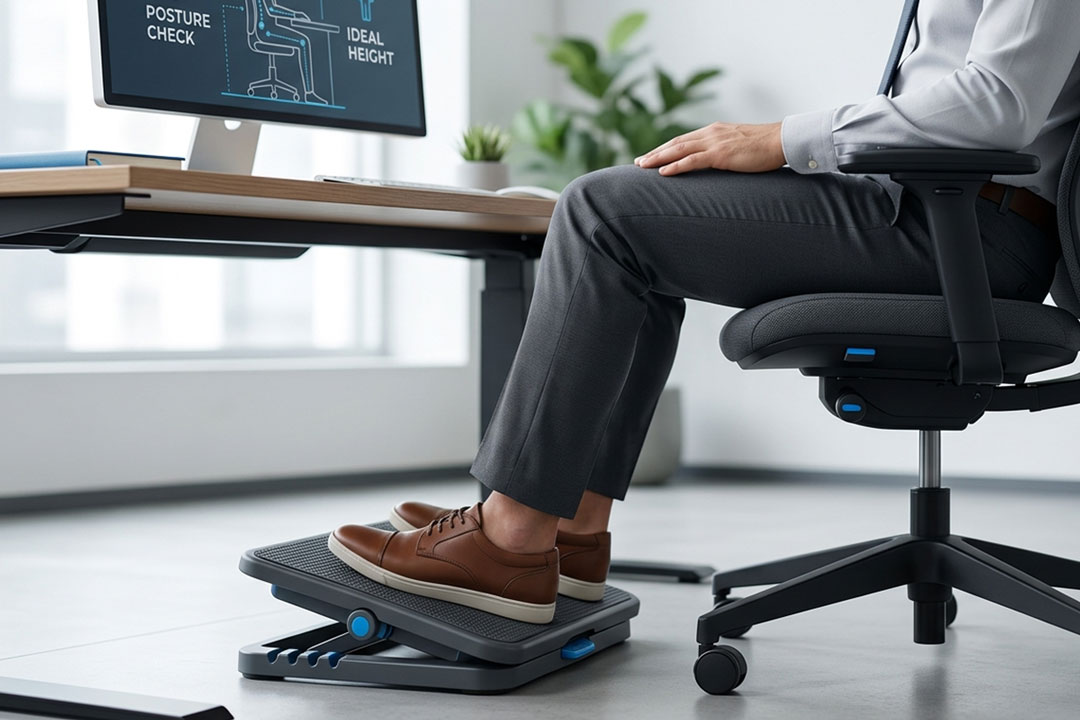
You sit down at your desk at 9 AM. By 11, your lower back is already complaining. By 2 PM, your legs feel heavy and restless. Sound familiar? You’re not alone. Millions of desk workers deal with the same creeping fatigue every single day.
Knowing how to choose footrest height correctly is one of the single most impactful ergonomic decisions you can make for your workspace.Most people try to fix it by adjusting their chair. If you want to know how to choose the footrest height for your workstation, you need to look at your setup from the ground up. They raise it, lower it, fidget with the lumbar support. But here’s the thing – if your feet can’t rest flat and comfortably on a surface, no amount of chair tweaking will fully solve the problem. Dangling feet create a chain reaction of tension that travels up through your knees, hips, and into your spine.
That’s exactly where a footrest comes in. But not just any footrest – the right one, set at the right height. Knowing how to choose footrest height correctly is one of the single most impactful ergonomic decisions you can make for your workspace. It sounds simple. It kind of is. But most people skip this step entirely.
In this guide, we’re breaking it all down for you. You’ll learn the science behind proper foot positioning, a simple step-by-step measurement method, and how to tailor everything to your specific body type and pain points. No jargon. No guesswork. Just clear, actionable advice that your body will thank you for.
Why Proper Footrest Height Matters for Your Body
Your body works as one connected system. What happens at your feet doesn’t stay at your feet. Ergonomists call this the kinetic chain – the idea that every joint and muscle group is linked, and tension in one area ripples upward.
When your feet don’t have proper support, your thigh muscles engage just to hold your legs in place. That constant low-level engagement tightens your hip flexors. Tight hip flexors tilt your pelvis forward. And a tilted pelvis flattens the natural curve of your lower spine, which is a direct path to chronic back pain, neck stiffness, and even headaches.
So foot positioning really does matter – a lot more than most people realise.
When a Footrest Is Too High
If your footrest is set too high, your knees end up above your hips. This position compresses the hip joint and puts enormous pressure on the back of your thighs. Over time, it restricts blood flow and causes that familiar “pins and needles” sensation in your legs.
When a Footrest Is Too Low
A footrest that’s too low forces you to stretch your legs downward. Your thigh muscles work harder to maintain contact with the surface, and your lower back rounds to compensate. It’s only slightly better than having no footrest at all.
Getting the height just right is about achieving neutral joint positions – where nothing is strained, and everything is supported. If you’re not yet sure about the broader benefits of using a footrest, check out this detailed breakdown on the benefits of using a footrest under desk.
The 90-90-90 Ergonomic Rule Explained
If you’ve ever googled ergonomic sitting posture, you’ve probably come across the 90-90-90 rule. It’s the gold standard – and for good reason. It’s practical, measurable, and it works.
Here’s what it means: when you’re seated correctly, three major joints should each be at approximately a 90-degree angle.
- Elbows: Bent at 90 degrees, with your forearms resting parallel to the desk surface. This prevents shoulder and wrist strain.
- Hips: Bent at 90 degrees, with your thighs parallel to the floor. This keeps your pelvis in a neutral, upright position.
- Knees: Bent at 90 degrees, with your lower legs perpendicular to the floor. This means your feet need a flat, stable surface to rest on.
That last point is the critical one. Your feet act as the foundation – the anchor – for the entire setup. Without solid foot support, the rest of the chain collapses. Your knees drift, your hips tilt, your back curves.
The Mayo Clinic and other leading health authorities consistently emphasise that feet should be flat on the floor or on a footrest, with thighs roughly parallel to the ground. It’s not optional advice. It’s the baseline for any healthy seated posture.
The problem is that most office setups aren’t built around the 90-90-90 rule. Desks are fixed. Chairs have limits. And the average person’s body doesn’t fit neatly into a standard-height workspace. That’s exactly why a well-chosen footrest bridges the gap – literally.
Step-by-Step Guide: How to Choose Footrest Height and Measure Correctly
Ready to stop guessing and start measuring? Follow these three steps in order. You’ll need a tape measure and about five minutes.
Step 1: Adjust Your Office Chair First
Before you think about a footrest, your chair needs to be set correctly for your desk. This is the starting point – everything else builds from here.
Sit down and let your arms hang naturally at your sides. Then bend your elbows to 90 degrees. Your forearms should land at desk height – or very close to it. If they’re too high or too low, adjust your chair up or down until that alignment is right.
Once your chair is set for elbow alignment, take notice of your feet. Are they flat on the floor? Or are they dangling? If they’re dangling – even slightly – that’s your signal that you need a footrest.
Important: Don’t drop your chair just to get your feet on the floor. That would compromise your elbow and shoulder alignment. The footrest fills that gap instead – and that’s the whole point.
Step 2: Measure the Gap Between Your Feet and the Floor
This is the key measurement. Sit in your properly adjusted chair with your thighs parallel to the floor and your knees bent at 90 degrees.
Now measure from the back of your knee (the crease where your thigh meets your lower leg) straight down to the floor. This gives you your popliteal height – the term ergonomists use for the seated leg length.
Compare that measurement to your actual chair height. The difference between where your feet naturally hang and the floor is the gap your footrest needs to fill.
For example, if your chair seat is 46 cm off the ground, and your popliteal height is 40 cm, your feet are dangling 6 cm above the floor. You’ll need a footrest that’s roughly 6 cm tall.
Pro tip: Measure while wearing the shoes you normally wear at your desk. Shoe thickness – especially with thick-soled trainers or boots – can shift your needs by 1 to 3 cm.
Step 3: Determine Your Ideal Footrest Thickness
Once you have your gap measurement, the formula is straightforward:
Ideal Footrest Height = Chair Height − Your Popliteal Height
So, if your chair height is 48 cm and your popliteal height is 42 cm, you need a footrest that’s 6 cm thick. Simple.
For most people, the ideal footrest height lands somewhere between 5 cm and 15 cm (roughly 2 to 6 inches). Those outside that range – particularly shorter individuals – often need to be more intentional about their choice.
Also consider the tilt. Many footrests offer an angled surface. A slight forward tilt of around 10 to 15 degrees promotes gentle movement and reduces static pressure on the heels. It also engages your calf muscles slightly, which helps with circulation during long sitting sessions.
How to Choose Footrest Height Based on Personal Needs
Ergonomics isn’t one-size-fits-all. Your body, your pain points, and your lifestyle all affect what the “right” footrest height actually means for you. Here’s how to think about it based on your specific situation.
For Shorter Individuals
Standard office furniture is typically designed around a person who is 5’8″ to 5’10”. If you’re shorter than that, you’re fighting an uphill battle every single day.
When you raise your chair to reach your desk properly, your feet often have no chance of touching the floor. Standard footrests may not be tall enough to bridge that gap. This leaves you perched uncomfortably, with your legs dangling and your thighs pressing hard against the seat edge – cutting off circulation.
Shorter individuals typically need a footrest that’s 10 cm or more in height, often with a tilt to match the natural angle of the lower leg. Choosing the right product can make an enormous difference. Learn more about finding the best under desk foot rest for short legs.
For Managing Sciatica and Joint Pain
Sciatica is that burning, shooting pain that travels down from the lower back through the buttocks and into the leg. It happens when the sciatic nerve gets compressed or irritated – often by sitting in a poorly supported position for hours.
When your feet dangle, your pelvis tilts and your lumbar spine flattens. That flattening narrows the space around the lower vertebrae and puts direct pressure on the sciatic nerve root. A footrest that brings your feet to the right height restores the natural lumbar curve, which relieves that pressure almost immediately.
Look for a footrest with light cushioning and a slight tilt to encourage micro-movement. This keeps blood moving and prevents prolonged nerve compression. Explore the full guide on finding the best under desk foot rest for sciatica relief.
For Knee Pain and Joint Support
The knee is the most load-bearing joint in the body when seated – and it’s often overlooked. When your footrest is too high, the knee flexes beyond 90 degrees, compressing the joint. Too low, and the knee extends slightly, pulling on the ligaments below the kneecap.
The ideal knee angle is between 90 and 110 degrees – slightly more open than a perfect right angle. This reduces joint pressure while keeping the muscles around the knee engaged without strain.
Soft, slightly cushioned footrests with a gentle tilt work best for people with knee issues. They allow the joint to sit in a more natural, open position. Read our dedicated guide on finding the right under desk foot rest for knee pain.
For Reducing Swollen Feet and Improving Circulation
Swollen feet and ankles after a long day at the desk are your body’s way of telling you that blood isn’t circulating well through your lower limbs. Prolonged sitting, especially with unsupported feet, causes blood to pool in the veins of the legs.
A footrest helps in two ways. First, it keeps your legs at the right angle so the calf muscles aren’t being compressed against the seat edge. Second, a rocking or massage-surface footrest encourages regular micro-movement, which activates the calf muscle pump – the mechanism your body uses to push blood back up toward the heart.
For people who deal with regular swelling, a slightly elevated and angled footrest is often more effective than a flat one. Discover the best options in our guide to the best under desk foot rest for swollen feet.
Fixed Height vs. Adjustable Footrests
Once you know the height you need, the next question is: should you get a fixed-height footrest or an adjustable one?
Fixed-height options – like simple wooden blocks, foam wedges, or firm platforms – are affordable, stable, and often very durable. If your measurements are consistent and you always wear similar shoes, a fixed footrest can work perfectly well.
But here’s the catch: our feet don’t always need the same height. You might wear flat shoes on Monday and thick-soled boots on Wednesday. Your legs might feel different after a standing meeting versus a morning of sitting. Swelling changes foot size. Pregnancy changes posture.
Adjustable footrests address all of that. They let you dial in the exact height and tilt you need – and change it as needed throughout the day. They’re especially valuable in shared workspaces where multiple people use the same desk setup.
If you’re not sure which type is right for you, our adjustable foot rest buying guide walks through the top options in detail, with recommendations for different budgets and use cases.
Common Warning Signs Your Footrest Height Is Wrong
Your body will tell you when something’s off – if you know what to look for. Watch for these red flags:
- Your knees are higher than your hips – this compresses the hip flexors and flattens the lumbar curve.
- Your thighs are lifting off the seat – the footrest is too thick and is pushing your knees up.
- You constantly cross your ankles or tuck your feet under the chair – a classic sign your feet aren’t comfortable where they are.
- You experience tingling or numbness in your legs – pressure on the thigh or sciatic nerve from improper positioning.
- You keep sliding forward in your chair – often caused by trying to reach a footrest that’s too far away.
- Your lower back aches by midday – the footrest isn’t restoring the natural lumbar curve it should.
- Your heels are resting on the footrest but your toes are pointing up – the tilt angle is wrong, causing calf tension.
- You feel more tired in the afternoon than you should – poor leg circulation caused by unsupported feet drains energy faster.
If you notice any of these signs, it’s time to remeasure and readjust. Even a 2 cm change in footrest height can make a significant difference.
Final Verdict & Practical Summary
Ergonomics is deeply personal. Your ideal setup won’t look exactly like your colleague’s or your partner’s. The measurements that work for a 6-foot tall person will be completely wrong for someone who’s 5’3″.
But the process is the same for everyone. Set your chair height based on elbow alignment first. Measure the gap between your feet and the floor. Choose a footrest that fills that gap – adjustable if your situation varies, fixed if it doesn’t.
Take five minutes to do this right. It’s five minutes that could save you months of back pain, sciatica flare-ups, and afternoon fatigue. And once it’s done, you’ll wonder why you didn’t sort it out sooner.
When you know how to choose footrest height correctly, you’re not just making your desk more comfortable. You’re investing in the long-term health of your spine, your joints, and your energy levels. That’s worth doing properly.
Frequently Asked Questions (FAQs)
Q1: What is the ideal height for an under-desk footrest?
There’s no single universal answer – it depends on your body dimensions and chair setup. However, for most office workers, the ideal footrest height falls between 5 cm and 15 cm (2 to 6 inches). The correct height is the one that lets your thighs sit parallel to the floor, your knees bend at 90 degrees, and your feet rest flat without any strain. Measure the gap between your heels and the floor when your chair is properly set, and that number is your ideal footrest height.
Q2: Can an under-desk footrest be too high?
Absolutely, yes. A footrest that’s too high pushes your knees above your hips, which tilts your pelvis and arches your lower back. It also increases pressure on the back of the thighs and can restrict circulation. If you notice your knees rising above hip level, or if your thighs are lifting off the seat when you use the footrest, it’s too thick. Either switch to a lower-profile model or look for an adjustable footrest that lets you fine-tune the height.
Q3: Should my feet be flat or at an angle on a footrest?
Both positions have merit, but a slight angle is generally better. A flat surface is fine for short-term use, but a footrest with a forward tilt of around 10 to 15 degrees promotes a more natural lower-leg position, reduces pressure on the heels, and encourages gentle calf muscle engagement. This slight activation helps circulation and prevents the stiffness that comes from holding any one position for too long. If you have a rocking footrest, even better – the motion keeps blood flowing throughout the day.