
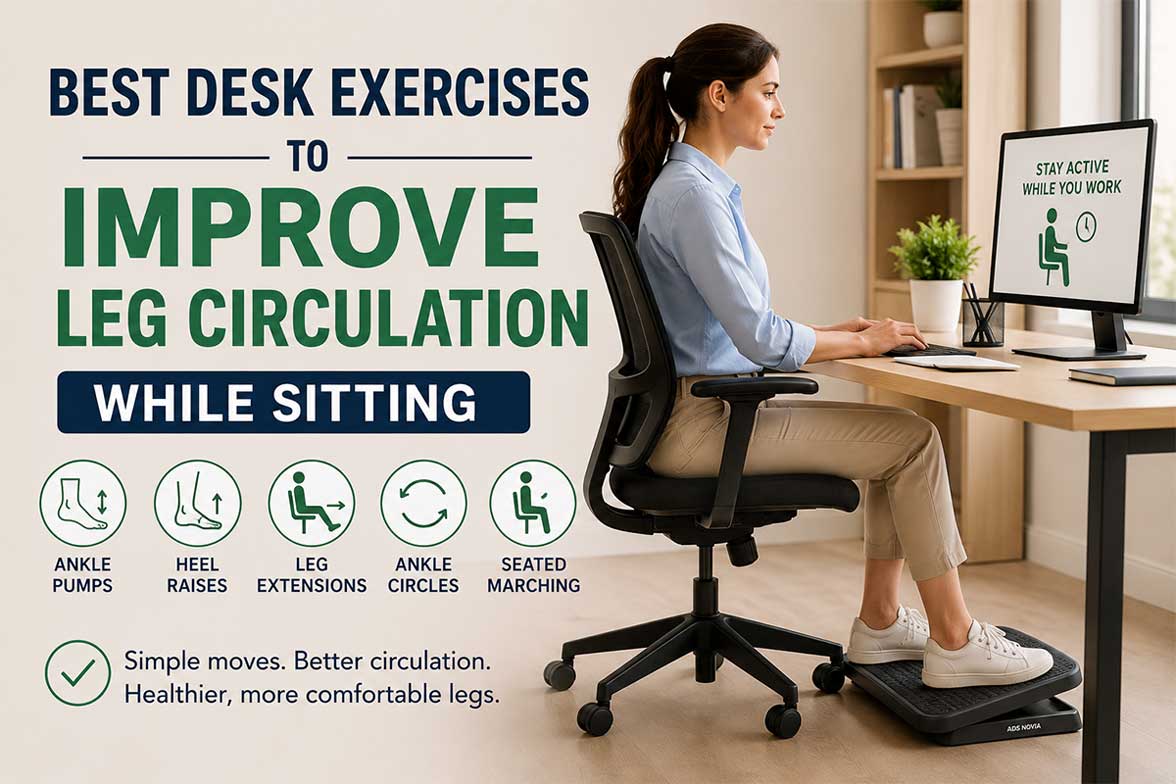
It usually starts with a dull ache somewhere around your calves, then a pins-and-needles feeling in your feet, and before you know it your legs feel like they belong to someone else. If you sit for six or more hours a day, this is probably a familiar story. The good news is that the best desk exercises to improve leg circulation while sitting are simple, discreet, and take only a few minutes spread across your workday. You do not need gym gear, extra space, or a standing desk to get started.
| Quick Answer |
| The most effective desk exercises for leg circulation are ankle pumps, heel raises, toe raises, seated leg extensions, ankle circles, and marching in place. Doing these for 2–3 minutes every 30–60 minutes while sitting keeps your calf muscle pump active, moves blood back toward the heart, and reduces the heaviness and fatigue that build up during long periods of sitting. |
Why Does Sitting Too Long Reduce Leg Circulation?
Prolonged sitting slows blood flow in your legs because your muscles are doing almost nothing, and muscles are the engine that drives circulation in the lower body.
When you walk or stand, your calf muscles contract and squeeze the veins around them, pushing blood upward toward the heart. This is called the calf muscle pump, and it is one of the most important mechanisms your body uses to circulate blood against gravity. When you sit still for extended periods, that pump goes idle.
Without regular muscle activity, blood tends to pool in the lower legs and feet. The veins become less efficient at returning blood to the heart, and the tissues in your legs receive less fresh, oxygenated blood. Over time this causes the familiar sensations of heaviness, fatigue, and swelling that many office workers experience by mid-afternoon.
Research and clinical guidance from institutions like the Mayo Clinic note that long periods of immobility are among the key risk factors for blood pooling and, in more serious cases, deep vein thrombosis (DVT). Regular movement breaks are one of the most practical preventive measures available. You can also learn more about the underlying causes in our article on how sitting too long affects leg circulation.
Common Signs That Your Leg Circulation Needs More Movement
Your body usually gives you clear signals before a problem becomes serious. Watch for these:
- Heavy or leaden legs that feel harder to lift than usual
- Persistent leg fatigue even though you have not done any physical exercise
- Tingling or a pins-and-needles sensation in your feet or calves
- Visible or felt swelling around the ankles and feet by the afternoon
- Stiffness in the knees or hips after standing up from a long sit
- Mild numbness that fades quickly once you start moving
- A general sense of restlessness in the legs, sometimes called restless leg sensation
If you regularly experience swollen feet after long work sessions, our guide on why feet swell while sitting explains the physiology in plain terms and offers practical next steps.
Best Desk Exercises to Improve Leg Circulation While Sitting
You do not need to leave your chair for any of the exercises below. Each one targets the muscles and joints most responsible for keeping blood moving in your lower body. Aim to do a short set of these every 30 to 60 minutes during your workday. Even two or three minutes of movement makes a measurable difference.
Ankle Pumps
Why it helps: Ankle pumps directly activate the calf muscle pump — the same mechanism that works when you walk. Every time you flex and point your foot, the calf contracts and squeezes blood upward through the veins.
How to do it: Sit tall with both feet flat on the floor. Slowly lift your toes toward your shins (dorsiflexion), hold for one second, then press your toes down toward the floor (plantarflexion). That is one rep.
Duration: 15–20 repetitions per set, 2–3 sets per hour.
Common mistake: Rushing through the movement. Slow, deliberate pumps activate the muscle more fully than quick flicks.
Heel Raises
Why it helps: Lifting your heels off the floor shortens the calf muscle against resistance (your body weight), which creates a strong pumping action in the veins running through the lower leg.
How to do it: Keep your toes on the floor and raise both heels as high as you can. Hold briefly at the top, then lower slowly.
Duration: 15 repetitions per set. You can add resistance by placing your hands lightly on your thighs.
Common mistake: Letting the heels drop suddenly. A controlled descent on the way down is just as important as the lift.
Toe Raises
Why it helps: Toe raises work the shin muscles (tibialis anterior) and stimulate circulation in the front of the lower leg, complementing the calf-focused exercises above.
How to do it: Keep your heels on the floor and lift your toes and the front of your foot as high as you can. Hold for two seconds, then lower.
Duration: 15–20 repetitions. Alternate with heel raises for a balanced set.
Common mistake: Only lifting the toes slightly. Try to get a full range of motion to engage the muscle properly.
Seated Leg Extensions
Why it helps: Straightening the leg engages the quadriceps and hamstrings, which are large muscle groups with significant blood vessels running through them. Contracting these muscles helps move blood through the thigh and into the core circulation.
How to do it: Sit upright and straighten one leg until it is roughly parallel to the floor. Hold for 3–5 seconds, then slowly lower. Alternate legs.
Duration: 10 repetitions per leg, 2 sets.
Common mistake: Swinging the leg upward using momentum. The movement should be slow and controlled from the thigh muscle.
Calf Muscle Stretch
Why it helps: Tight calf muscles can restrict blood flow on their own. A seated calf stretch releases that tension and encourages better circulation through the lower leg. It also relieves the stiffness that comes from holding the same foot position for hours.
How to do it: Extend one leg forward with the heel resting on the floor. Flex your toes back toward your shin until you feel a gentle stretch along the back of the calf. Hold for 20–30 seconds, then switch.
Duration: 2–3 repetitions per leg.
Common mistake: Reaching forward and rounding your back. Try to keep your spine straight and let the ankle do the work.
Ankle Circles
Why it helps: Rotating the ankle moves the joint through its full range of motion and stimulates the many small blood vessels and muscles surrounding the ankle, which is a key area where blood tends to pool.
How to do it: Lift one foot slightly off the floor. Draw large, slow circles with your toes — 10 clockwise, then 10 counter-clockwise. Repeat with the other foot.
Duration: 10 circles each direction, each foot.
Common mistake: Making tiny circles. Bigger circles recruit more muscle and give you more circulatory benefit.
Marching While Sitting
Why it helps: Seated marching mimics the natural walking motion and alternately contracts the hip flexors, quadriceps, and calves. It is one of the most comprehensive circulation exercises you can do without standing.
How to do it: Sit up straight and alternate lifting each knee toward your chest as if you are marching in slow motion. Swing your arms gently if you want to increase the effect.
Duration: 30–60 seconds per set.
Common mistake: Slouching forward as you lift your knees. Maintain good posture throughout — the benefits are greater when your spine is upright. For more strategies to address that leaden feeling at the end of a long workday, see our dedicated guide on how to relieve heavy legs after sitting all day.
Exercise Comparison at a Glance
| Exercise | Target Area | Time Per Set | Difficulty |
| Ankle Pumps | Calves / Veins | ~60 seconds | Easy |
| Heel Raises | Calves | ~45 seconds | Easy |
| Toe Raises | Shins / Ankles | ~45 seconds | Easy |
| Seated Leg Extensions | Quadriceps / Hamstrings | ~90 seconds | Moderate |
| Calf Muscle Stretch | Calf / Achilles | ~60 seconds | Easy |
| Ankle Circles | Ankle / Lower Leg | ~60 seconds | Easy |
| Marching While Sitting | Full Lower Body | ~60 seconds | Easy |
How Often Should You Perform Desk Exercises?
A good general rule is to move for 2–3 minutes for every 30–60 minutes of uninterrupted sitting. That is a realistic target for most office schedules and aligns with guidance from occupational health professionals.
Here is a practical schedule you can follow:
- Every 30 minutes: Ankle pumps and toe raises (about 90 seconds total)
- Every 60 minutes: A full set of heel raises, ankle circles, and seated leg extensions (about 3 minutes)
- Every 2 hours: Add a standing break of at least 5 minutes — walk to the kitchen, take a brief walk around the office, or use the stairs
- End of day: Spend 5–10 minutes walking or stretching your legs before transitioning to an evening of sitting
If a timer helps you remember, many people use their phone alarm, a productivity app, or even a wearable fitness tracker to nudge them into movement every hour.
Can a Footrest Help Improve Leg Circulation?
Yes — a well-positioned footrest can meaningfully support leg circulation, though it works best as a complement to movement rather than a replacement for it.
When your feet dangle or your chair height does not allow them to rest flat on the floor, your thighs press upward against the seat edge and compress the blood vessels running through the backs of your legs. A footrest eliminates that compression by providing a stable surface for your feet at the right height, keeping your knees at roughly a 90-degree angle and your legs in a neutral position. This alone reduces one of the main contributors to restricted circulation in seated workers.
Footrests with a rocker or tilt function offer an additional benefit: they allow you to gently shift your foot angle throughout the day, which keeps the ankle joint moving and provides a mild version of the calf pump effect even when you are focused on screen work. You can explore whether a footrest is right for your setup in our overview of the benefits of using a footrest under your desk, or check out our in-depth piece on whether footrests actually improve blood circulation while sitting.
If you have foot swelling specifically, our guide on under-desk foot rests for swollen feet covers which types of footrests are best suited to that situation.
Additional Tips for Better Circulation During Desk Work
Movement is the most powerful tool you have, but a few habits around your workstation setup and daily routine make a significant difference too.
- Stay hydrated: Dehydration thickens the blood slightly and makes circulation less efficient. Aim for consistent water intake throughout the day rather than drinking large amounts all at once.
- Take standing breaks: Even a two-minute stand and brief walk every hour helps reset the calf pump and gives your spine a rest. A sit-stand desk is helpful but not essential — simply standing and shifting your weight works.
- Set your chair height correctly: Your feet should rest flat on the floor (or a footrest) with your knees at roughly 90 degrees. A chair that is too high lets your feet dangle; one that is too low compresses the thighs. See our article on how desk chair height affects leg comfort and circulation for detailed guidance.
- Check your feet position: Crossing your legs at the knee significantly compresses blood vessels and restricts venous return. Try to keep both feet on the floor or on a footrest. Our guide on how to position your feet correctly while sitting walks through the ideal posture in detail.
- Use movement reminders: Whether it is a calendar reminder, a wearable alert, or a sticky note on your monitor, a consistent nudge to move is one of the highest-leverage habits you can build.
- Wear comfortable footwear: Tight shoes or high heels restrict blood flow in the foot and can worsen swelling. If possible, opt for low-heeled, supportive footwear during long sitting sessions.
Daily Desk Circulation Checklist
| Checklist: Circulation-Friendly Desk Habits |
|---|
| Morning setup |
| ☐ Adjust chair so feet rest flat on the floor or a footrest |
| ☐ Set a movement reminder for every 45–60 minutes |
| ☐ Have a water bottle within reach |
| Throughout the day |
| ☐ Ankle pumps or toe raises every 30 minutes |
| ☐ Full exercise set (3 minutes) every hour |
| ☐ Stand up and walk for 2–5 minutes every 2 hours |
| ☐ Avoid crossing legs at the knee |
| End of day |
| ☐ Take a 5–10 minute walk before a long evening of sitting |
| ☐ Do a standing calf stretch before bed if legs feel tight |
Common Mistakes That Reduce the Benefit of Desk Exercises
- Doing all your exercises in one burst rather than spreading them out — frequent small sessions beat one long session
- Moving too quickly through each exercise and losing the muscle engagement benefit
- Skipping exercises on busy days when your legs need movement the most
- Sitting with your legs crossed, which cancels out any circulation benefit from your exercises
- Forgetting about posture — slouching compresses the abdomen and restricts blood flow just as much as poor leg position
- Relying on exercises alone while ignoring chair height, foot position, and hydration
Frequently Asked Questions
How long does it take for leg circulation to improve from desk exercises?
Most people notice a reduction in heaviness and tingling within the first few days of consistent movement breaks. Structural improvements in vein efficiency take longer — usually a few weeks of regular activity — but the short-term relief is almost immediate.
Can desk exercises actually prevent blood clots?
Regular movement significantly reduces the risk of blood pooling, which is a contributing factor to clot formation. However, desk exercises are a preventive wellness habit, not a medical treatment. If you have a personal or family history of deep vein thrombosis or other vascular conditions, consult your doctor for tailored guidance.
Which desk exercise is best for swollen ankles specifically?
Ankle pumps are the most targeted option for ankle swelling because they directly activate the venous pump in the calf and encourage fluid to move away from the feet. Elevating your feet on a footrest after a long session can help as well.
Is it better to stand up or do seated exercises?
Both are beneficial and ideally you do both. Seated exercises maintain circulation during the stretches when standing is not practical. Standing breaks give your spine a rest and engage slightly different muscle groups. They complement rather than replace each other.
How do I know if my leg symptoms are serious?
Mild heaviness and fatigue that improve with movement are usually a normal response to prolonged sitting. Persistent pain in one leg, redness, significant warmth, or swelling that does not reduce after movement and rest are symptoms that warrant medical attention. These could indicate a circulatory issue that needs a professional evaluation.
Can these exercises help with leg numbness?
Yes, in most cases. Numbness from sitting is usually caused by pressure on nerves or reduced blood flow, both of which are addressed by movement. Our separate guide on how to prevent leg numbness while sitting goes into more detail on the causes and solutions.
Do I need to stand at a standing desk to improve circulation?
No. A standing desk can help if used correctly (alternating between sitting and standing), but it is not required. The desk exercises in this article are effective for people who sit all day, and frequent seated movement breaks can achieve similar results to occasional standing.
Why do my legs feel better after walking but worse after sitting?
Walking activates the calf muscle pump continuously, which clears pooled blood and delivers fresh oxygenated blood to the leg tissues. Sitting shuts that pump down. The contrast is one of the clearest signals your body gives you that more movement is needed. We have a dedicated article exploring why legs feel heavy after sitting but better after walking if you want a deeper explanation.
| Key Takeaways |
|---|
| Sitting for long periods reduces leg circulation by deactivating the calf muscle pump. |
| Ankle pumps, heel raises, and seated leg extensions are the most effective desk exercises for circulation. |
| Aim to move for 2–3 minutes every 30–60 minutes — consistency matters more than duration. |
| A correctly positioned footrest supports circulation by preventing thigh compression. |
| Chair height, foot position, and hydration amplify the benefits of movement. |
| Persistent or one-sided leg pain, redness, or warmth are symptoms that need medical evaluation. |
Final Thoughts
The best desk exercises to improve leg circulation while sitting do not require extra equipment, a gym membership, or even a break from your screen. A few targeted movements — ankle pumps, heel raises, seated marching — done consistently throughout the day are enough to keep blood moving, reduce fatigue, and protect against the chronic discomfort that comes from hours of uninterrupted sitting.
Start small. Pick two or three of the exercises above and commit to doing them every hour for a week. Once movement breaks become a habit rather than an afterthought, your legs will thank you by the end of every workday. If you want to go further, pairing these exercises with an ergonomically supportive workspace — the right chair height, a footrest if your feet cannot rest flat, and good foot positioning — makes a genuine difference. Our guide on the correct sitting position for all-day desk work is a good place to start building that bigger picture.