
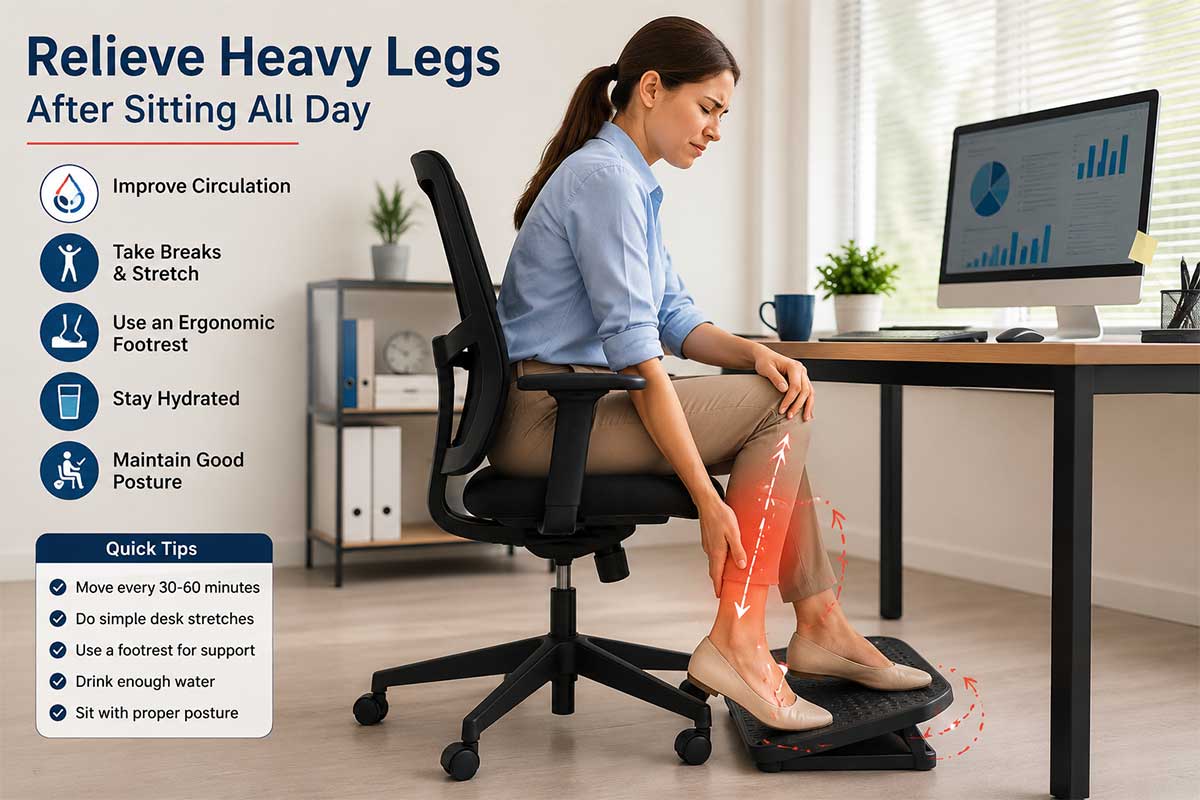
If you finish a long workday and notice your legs feel unusually heavy, tired, or stiff, you are not alone. This is one of the most commonly reported complaints among desk workers, remote employees, and anyone who spends six or more hours seated at a computer.
The sensation of heavy legs after sitting usually comes down to a combination of factors – reduced blood flow, prolonged muscle inactivity, poor posture, and fluid pooling in the lower limbs. While it may seem like a minor inconvenience, persistent leg heaviness can affect your focus, your comfort, and over time, your overall health.
The good news is that most cases are manageable with simple, practical changes to your daily desk routine. In this article, we explain exactly why your legs feel heavy after sitting and walk you through effective, evidence-informed strategies to relieve and prevent the problem.
Quick Answer
Heavy legs after sitting are caused by reduced blood flow, fluid accumulation, and muscle inactivity. To relieve them: take short walking breaks every 30–45 minutes, perform seated leg stretches, keep your feet flat and supported, stay hydrated, and maintain correct sitting posture throughout the day.
Common Causes and Solutions at a Glance
| Common Cause | Possible Effect | Practical Solution |
|---|---|---|
| Poor posture | Restricted blood flow in thighs and hips | Sit upright with feet flat, use lumbar support |
| Prolonged sitting | Muscle fatigue, reduced circulation | Move every 30–45 minutes, take walking breaks |
| Reduced circulation | Heaviness, tingling, swelling | Elevate feet, perform calf raises and ankle rolls |
| Lack of movement | Fluid pooling in lower legs | Desk stretches, light walking, standing intervals |
| Improper foot support | Pressure on thighs, restricted blood flow | Use an ergonomic footrest to keep feet supported |
Why Do Legs Feel Heavy After Sitting All Day?
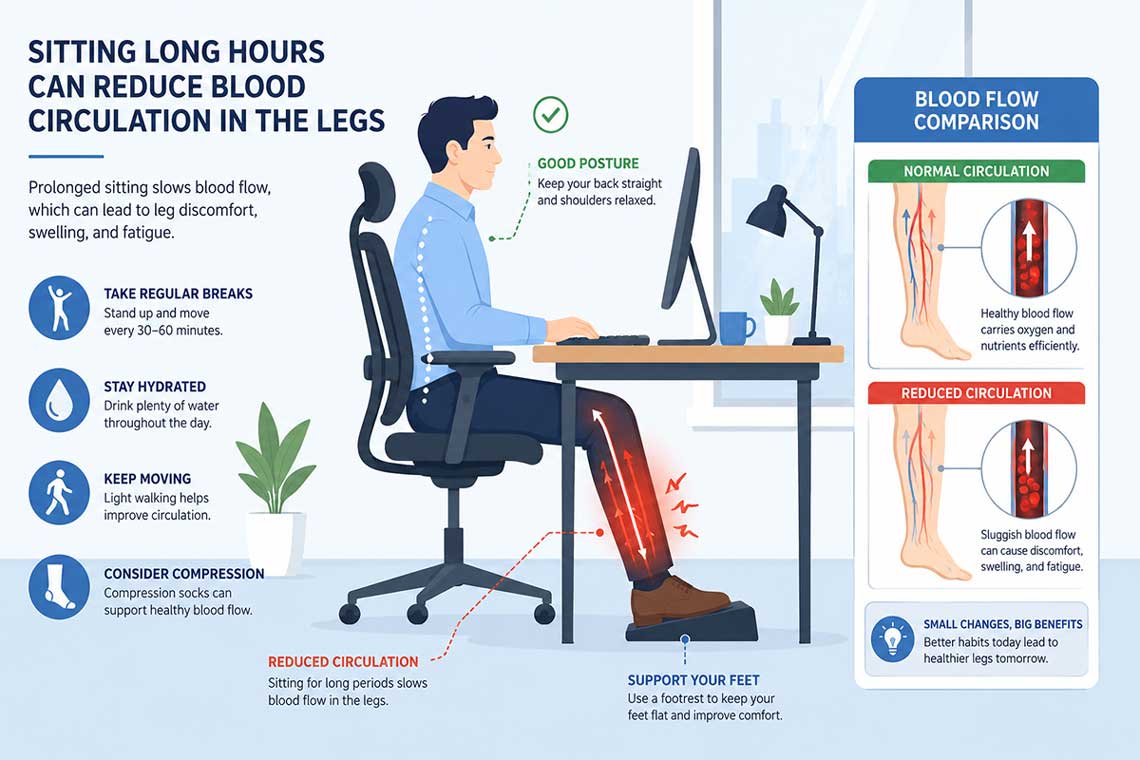
Leg heaviness during or after desk work is rarely random. It typically develops because your body is not designed to remain still for extended periods. When you sit for hours, several things happen inside your body that directly contribute to that familiar tired, sluggish sensation in your legs.
Poor Blood Circulation From Prolonged Sitting
When you sit down, particularly with your knees bent at a right angle and your thighs pressed against a chair seat, blood flow from the lower body back to the heart slows down. Your leg muscles, which normally help pump blood upward when you walk or stand, become largely inactive.
This reduced circulation is one of the primary reasons why legs feel heavy after sitting. According to the Mayo Clinic, prolonged sitting can negatively affect circulation and is linked to a range of cardiovascular and musculoskeletal concerns. Over the course of a long workday, this effect compounds – making that heavy feeling progressively worse as the hours pass.
If you are also experiencing reduced sensation or numbness, you may find our article on how to prevent leg numbness while sitting at a desk helpful alongside this one.
Muscle Inactivity During Desk Work
Your leg muscles – including the calves, quadriceps, and hamstrings – play an active role in supporting circulation. When you walk, they contract and release rhythmically, helping to push blood back up through the veins toward the heart. This is sometimes called the “muscle pump” effect.
When you sit still for hours, that pumping action essentially stops. Blood can pool in the lower limbs, venous return slows, and your legs gradually feel heavier and more fatigued. This is one reason why even a five-minute walk can bring noticeable relief.
Fluid Accumulation in the Lower Legs
Gravity pulls fluid downward throughout the day. When you are moving, your muscles help push excess fluid back up. When you are seated and still, that fluid can accumulate in the lower legs and feet – a process sometimes called dependent oedema.
In mild cases, this may simply feel like heaviness or mild tightness. In more pronounced cases, it can cause visible puffiness around the ankles and feet. We have covered this topic separately in our article on why feet swell while sitting if you want to explore that further.
Poor Sitting Posture
The way you sit has a direct impact on how your legs feel by the end of the day. Slouching forward, sitting with your legs crossed, or perching on the edge of your seat can all place uneven pressure on the thighs, restrict blood flow at the back of the knees, and create tension throughout the lower body.
Maintaining a correct sitting position for all-day desk work – with your back supported, feet flat, and hips at roughly a 90-degree angle – forms the foundation of any effective approach to reducing leg heaviness.
Common Signs of Heavy Legs Caused by Desk Work
Leg heaviness from prolonged sitting can present in a variety of ways. Some people experience all of these; others notice just one or two. Common signs include:
- A persistent feeling of tiredness or weight in the thighs, calves, or feet
- Mild aching or dull pain along the backs of the legs
- Stiffness when standing up after long periods of sitting
- Tingling or mild numbness, particularly in the feet and lower calves
- Slight swelling or puffiness around the ankles by the end of the day
- Reduced ability to concentrate, partly due to physical discomfort
- A sense of general fatigue in the legs even without physical exertion
These signs are typically temporary and improve with movement, posture correction, and proper support. However, if they are severe, persistent, or accompanied by pain, it is worth speaking to a healthcare professional.
How to Relieve Heavy Legs After Sitting at Work
The following strategies are practical, evidence-informed, and easy to incorporate into your existing workday. Most of them cost nothing and require only small changes to your habits.
Change Your Sitting Position Regularly
Staying locked in one position is one of the biggest contributors to leg heaviness. Even small adjustments – shifting your weight, uncrossing your legs, or temporarily sitting slightly forward or backward – can make a meaningful difference by redistributing pressure and encouraging blood flow.
Try to consciously change your seated position every 20 to 30 minutes. Set a subtle reminder if needed. This does not require standing up; simply varying how you are seated helps keep circulation from stagnating.
Take Short Walking Breaks
Walking is one of the most effective ways to reset your leg circulation during a workday. Even a two-to-five minute walk every 45 minutes can activate the muscle pump, move pooled fluid out of the lower limbs, and noticeably reduce the sensation of heavy legs by mid-afternoon.
If your workflow makes it difficult to leave your desk frequently, consider walking while on phone calls, taking the longer route to the printer or kitchen, or simply standing and pacing briefly during natural pauses in your work.
Perform Desk Stretches for Leg Circulation
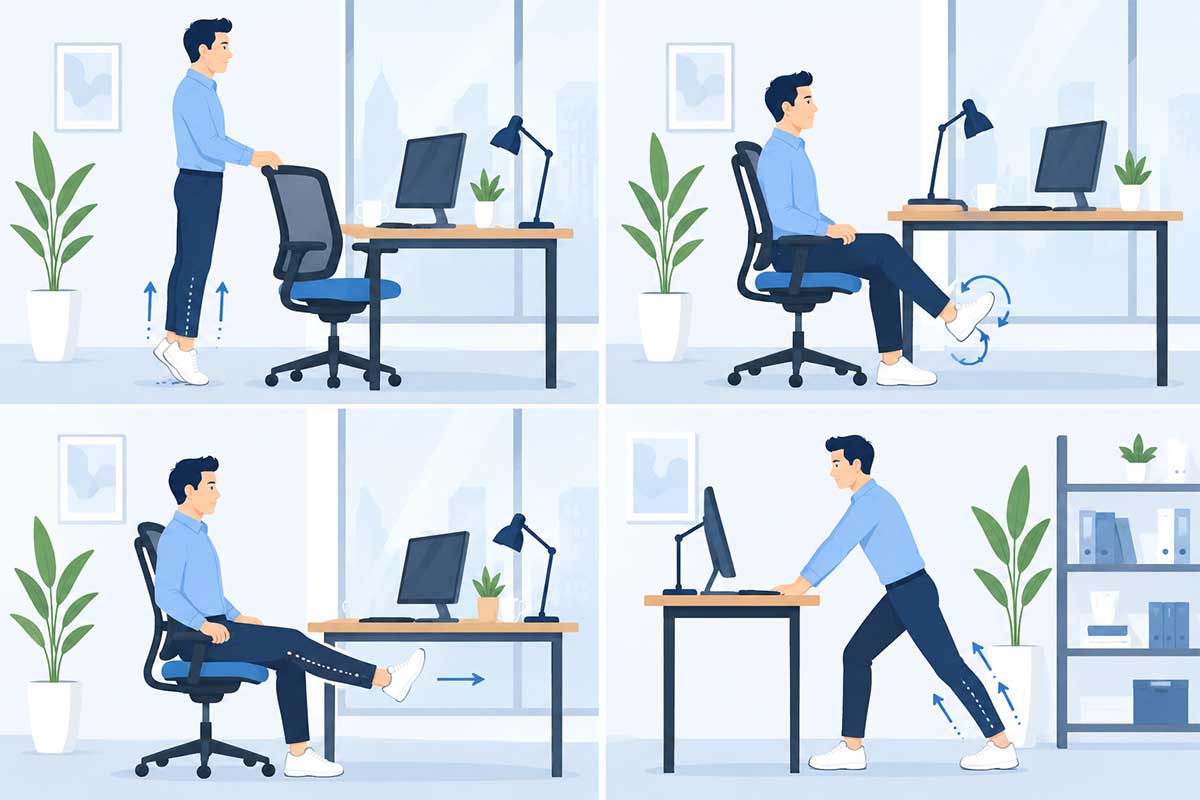
You do not always need to leave your desk to improve leg circulation. Several effective stretches can be done while seated or standing briefly at your workstation:
- Ankle circles: Lift one foot slightly off the floor and rotate the ankle 10 times in each direction. Alternate feet. This activates the calf muscles and encourages venous return.
- Seated calf raises: With both feet flat on the floor, raise your heels so you are on the balls of your feet, hold for two seconds, then lower. Repeat 15–20 times. This directly engages the calf muscle pump.
- Knee lifts: While seated, slowly lift one knee toward your chest, hold briefly, then lower. Alternate legs for 10 repetitions each. This engages the hip flexors and stimulates circulation in the upper leg.
- Seated hamstring stretch: Extend one leg out straight from your chair and flex your foot back toward you. Hold for 20–30 seconds. Switch sides. This reduces tightness in the back of the thigh and improves blood flow.
- Standing quad stretch: Stand briefly, hold your desk for balance, and pull one foot toward your glutes. Hold for 20 seconds per leg. This relieves tension in the front of the thigh.
For a more complete set of movement strategies, our article on how to reduce leg fatigue while sitting at a desk covers this topic in depth.
Elevate and Support Your Feet Properly
When your feet dangle or rest unevenly on the floor, the edge of your chair seat presses into the backs of your thighs. This can restrict circulation significantly over a long workday. Keeping your feet flat and properly supported removes that pressure and allows blood to flow more freely.
If your chair height means your feet do not rest comfortably flat, a footrest can help. Using a support under your feet keeps your legs at a more neutral angle and reduces the compression that contributes to heaviness and fatigue.
Stay Hydrated Throughout the Day
Dehydration contributes to poor circulation and can increase the likelihood of fluid retention in the lower limbs. When you are not drinking enough water, blood viscosity increases slightly, making it harder for your cardiovascular system to maintain efficient flow.
Aim to drink water consistently throughout the day rather than in large amounts infrequently. Keeping a water bottle at your desk serves as a practical reminder and also gives you a reason to get up and refill it periodically – which means more incidental movement.
Improve Your Overall Desk Ergonomics
Your physical setup matters more than most people realise. A chair that is too high forces your feet off the ground. A chair that is too low bends your knees too acutely and restricts circulation. A monitor positioned too low causes you to hunch forward, shifting weight unevenly onto your thighs.
Taking 15 minutes to properly adjust your workstation – chair height, monitor position, keyboard placement, and foot support – can have a disproportionately large impact on how your legs feel after a full workday.
Can an Ergonomic Footrest Help Reduce Heavy Legs?
For many desk workers, an ergonomic footrest is a practical and low-effort addition to their setup that can contribute meaningfully to leg comfort.
The primary benefit is postural: a footrest allows you to keep your feet properly supported regardless of your chair height or body proportions. When your feet rest flat on a surface – rather than dangling or pressing awkwardly on the floor – the pressure on the back of your thighs is significantly reduced. This alone can improve blood flow to the lower legs.
Beyond posture, many footrests are designed to encourage gentle movement. Rocking or tilting footrests allow you to shift the angle of your feet periodically, which engages the calf muscles slightly and helps maintain some level of the muscle pump effect even while seated.
If you are considering this option, our article on the benefits of using a footrest under desk provides a detailed overview of how foot support contributes to comfort and circulation. We also explore the specific question of whether footrests improve blood circulation while sitting if you want a more focused look at the circulation angle.
It is worth noting that a footrest is one useful tool among several. It works best in combination with good posture, regular movement, and the other strategies covered in this article – rather than as a standalone fix.
Mistakes That Can Make Heavy Legs Worse
Even well-intentioned desk workers often fall into habits that gradually worsen leg heaviness over the course of the day. Being aware of these common mistakes can help you avoid compounding the problem.
Sitting for Hours Without Movement
This is the single most impactful factor. Many people sit for three or four hours without standing up – either because they are focused on a task or because their workflow does not naturally prompt movement. Over time, this becomes the default, and the consequences for leg circulation are significant.
Building even minimal movement into your routine – a two-minute walk every hour, standing during a call – can make a substantial difference without disrupting your productivity.
Crossing Your Legs Frequently
Sitting with your legs crossed feels natural for many people, but it places uneven compression on the veins and soft tissue in the crossed leg. Done repeatedly or for extended periods, this habit can restrict circulation and contribute noticeably to that heavy, tired feeling.
Try to sit with both feet flat on the floor or on a footrest. If you catch yourself crossing your legs, simply uncross them. Consistency over time is more important than being perfect in any given moment.
Poor Chair Height
A chair that is set at the wrong height forces your body into a posture that creates problems throughout the lower limbs. Too high, and your feet hang off the ground, putting pressure on the backs of your thighs. Too low, and your knees rise above your hips, which strains the lower back and places unusual compression on the knee joints.
The correct height places your hips slightly above your knees, with your feet resting comfortably flat – either on the floor or on a footrest if needed.
Unsupported Feet
Feet that rest on the hard edge of a chair base, dangle freely, or press unevenly against the floor can restrict circulation at multiple points in the lower leg. This is a frequently overlooked issue, particularly for people whose legs are shorter or longer than the typical assumptions built into standard office chairs.
Proper foot support – through chair adjustment or a footrest – removes this source of compression and allows for better blood flow throughout the workday.
How to Prevent Heavy Legs During Long Desk Work Sessions
Prevention is considerably more effective than trying to relieve leg heaviness after it has already developed. The following habits, practised consistently, can significantly reduce how often you experience this problem:
- Set a timer or use a posture reminder app to prompt movement every 30–45 minutes
- Start each workday with a short walk or light leg stretches before sitting down
- Adjust your chair so your hips are slightly above your knees and your feet rest flat
- Place a footrest under your desk if your feet do not rest comfortably on the floor
- Drink water steadily throughout the day – at least 1.5 to 2 litres for most adults
- Avoid sitting with legs crossed, especially for extended periods
- Consider standing briefly during meetings, calls, or while reading documents
- Do a one-minute movement routine at the start of each new hour – ankle rolls, calf raises, or a brief walk
- Wear comfortable, non-restrictive clothing and footwear during desk sessions
- Review your workstation setup periodically to ensure your ergonomics remain well-adjusted
When Should You Seek Medical Advice?
For most desk workers, heavy legs are a comfort issue caused by inactivity and posture – and the strategies in this article will be sufficient to manage it effectively. However, there are some situations where it is worth speaking to a doctor.
Consider seeking medical advice if:
- Your leg heaviness is severe, persistent, or does not improve with movement and lifestyle changes
- You notice significant, asymmetrical swelling in one leg that does not reduce overnight
- You experience pain, redness, or warmth along the length of one leg
- You have shortness of breath, chest discomfort, or sudden pain in the calf
- You have a personal or family history of blood clots or deep vein thrombosis (DVT)
- The heaviness has appeared suddenly and without an obvious cause
These symptoms can occasionally indicate circulatory conditions that require professional assessment. Most of the time, heavy legs are entirely benign – but it is always sensible to err on the side of caution when something does not seem right.
Frequently Asked Questions
Why do my legs feel heavy after sitting all day?
Heavy legs after sitting are most commonly caused by reduced blood circulation, muscle inactivity, and fluid accumulation in the lower limbs. When you sit for extended periods, the calf muscle pump slows down, blood moves more sluggishly through the veins, and gravity pulls fluid toward the feet and ankles. The result is that characteristic feeling of tiredness and weight in the legs by the end of a long desk session.
Can poor circulation cause heavy legs?
Yes. Poor blood circulation from prolonged sitting is one of the primary contributors to leg heaviness at the desk. Reduced venous return means that blood and fluid are not moving efficiently back toward the heart, which causes the legs to feel congested, heavy, and fatigued. Improving circulation through movement, posture, and foot support generally reduces the problem.
Does a footrest help with heavy legs?
A footrest can contribute to relief by removing pressure from the backs of the thighs, encouraging a more neutral leg position, and in the case of rocking or tilting footrests, promoting gentle calf muscle activity. It works best as part of a broader approach that includes movement breaks and good sitting posture, rather than as a sole solution.
How often should I move during desk work?
Most ergonomics guidelines suggest taking a movement break at least every 30 to 45 minutes. Even a brief two-to-five minute walk, a round of seated leg exercises, or simply standing and shifting your weight can help maintain circulation and reduce leg heaviness accumulating over the course of the day.
Are heavy legs and swollen feet related?
Yes, they often share the same underlying cause. Both heavy legs and swollen feet during desk work are typically linked to fluid accumulation and reduced venous return from prolonged sitting. If your feet are swelling alongside the heaviness in your legs, our article on why feet swell while sitting provides more detailed information on that specific issue.
Can sitting posture affect circulation?
Absolutely. The way you sit directly influences how blood flows through the lower body. Slouching compresses the abdominal area, which can impede circulation. Sitting with legs crossed restricts venous flow in the crossed leg. Even sitting with your chair too high can cause the seat edge to compress the back of your thighs and reduce blood flow to the calves. Good posture helps maintain more open blood vessels and better overall circulation.
What stretches help relieve heavy legs?
Ankle circles, seated calf raises, knee lifts, seated hamstring stretches, and standing quad stretches are all effective for improving circulation in the legs during desk work. Performing these for just two to three minutes every hour can make a noticeable difference in how your legs feel throughout the day.
When should I be concerned about persistent leg heaviness?
If leg heaviness does not improve with rest and movement, is accompanied by significant swelling in one leg, causes pain or warmth along the leg, or appears alongside symptoms such as shortness of breath, it is worth consulting a doctor. These can occasionally indicate circulatory conditions that require professional evaluation. For most desk workers, however, persistent heaviness that improves with lifestyle changes is typically a posture and activity issue rather than a medical one.
Conclusion
Heavy legs after sitting all day are a common and largely preventable consequence of modern desk work. The root causes – reduced circulation, muscle inactivity, fluid accumulation, and poor posture – are all addressable with practical, everyday habits.
The most effective approach combines regular movement breaks, intentional desk stretches, proper sitting posture, adequate hydration, and a well-adjusted workstation. None of these changes require significant effort or expense; they simply require consistency.
If you are new to thinking about ergonomics at your desk, a good starting point is to focus on two things: move more often, and make sure your feet are properly supported. From there, the other habits become easier to layer in over time. For further reading, you may find our article on how to reduce leg fatigue while sitting at a desk a useful complement to this one. Small adjustments to how you sit and move during the workday can have a meaningful, lasting impact on how your legs – and your whole body – feel by the time you close your laptop.