
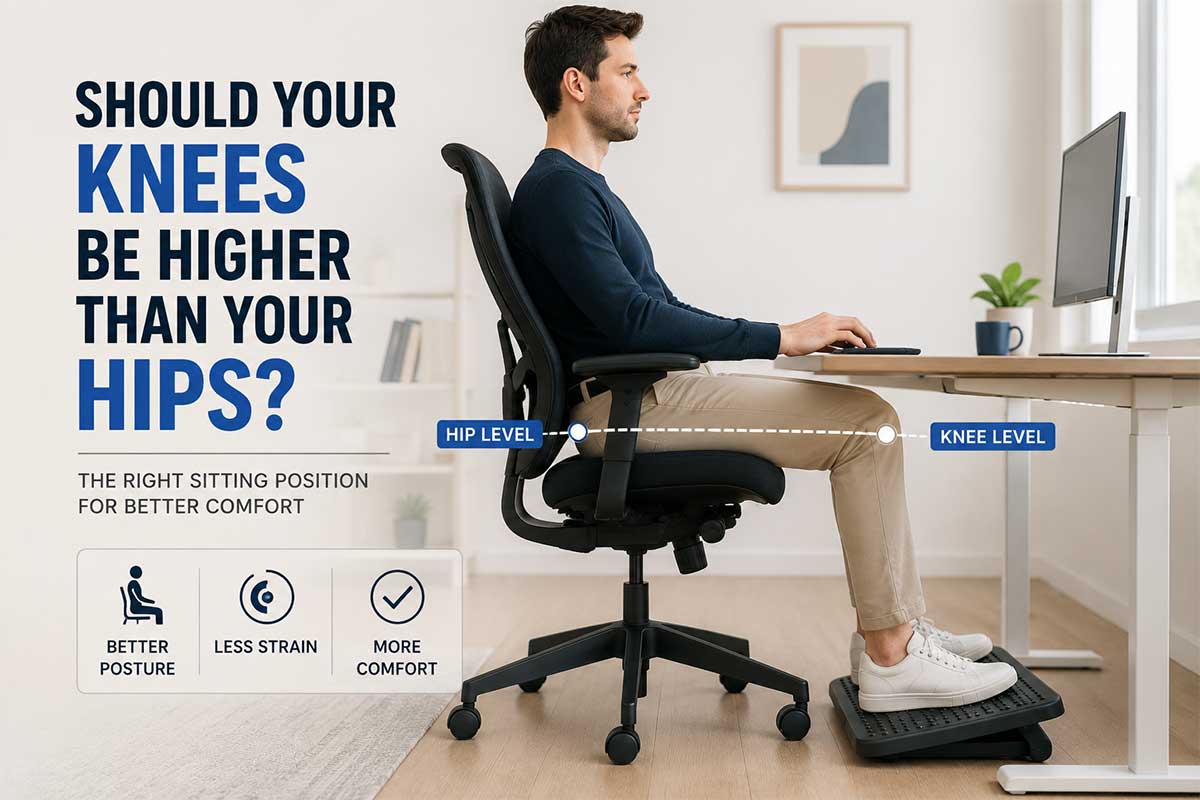
If you’ve ever adjusted your office chair and wondered whether your knees should sit above, level with, or below your hips, you’re asking a smarter question than most people think to ask. Chair height, desk height, and foot support all work together to shape this relationship, and getting it right can make a noticeable difference in how your lower back and legs feel by the end of the day. So, should your knees be higher than your hips when sitting at a desk? The short answer is usually no, but the full picture is a little more nuanced than a single rule can capture.
Quick Answer
In most cases, your knees should not be higher than your hips when sitting at a desk. For most people, keeping the knees level with or slightly lower than the hips helps maintain the spine’s natural curve and supports more even weight distribution through the pelvis. Chairs that sit too low, or footrests raised too high, can push the knees above hip level and may increase pressure behind the knees or encourage a backward pelvic tilt. Adjusting chair height and using a properly sized footrest can help most people find a more balanced, comfortable position.
Why Knee and Hip Position Matters for Desk Comfort
The relationship between your knees and hips affects far more than just how your legs feel. It influences how your pelvis is oriented, how your spine’s natural curves are supported, and how evenly your body weight is distributed across the seat. When the knees sit noticeably higher or lower than the hips, the pelvis often tilts in response, which can change the alignment of the entire spine above it.
This is one reason ergonomic guidance rarely focuses on the knees alone. Knee height is really a downstream effect of chair height, desk height, and how your feet are supported. Small adjustments in one area often ripple through the entire sitting posture, which is why this topic connects closely with broader guidance on maintaining a correct sitting position for all-day desk work.
Should Your Knees Be Higher Than Your Hips When Sitting at a Desk?
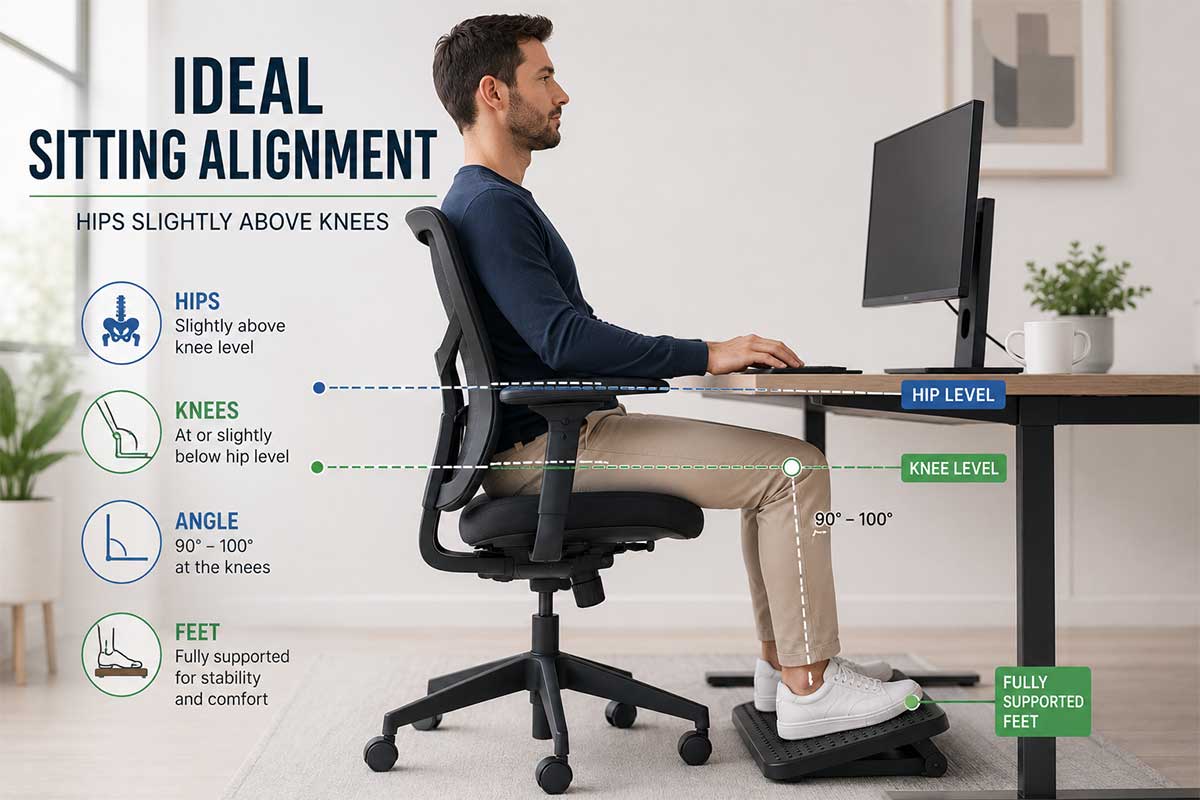
For most desk-based tasks, your knees should not be higher than your hips when sitting at a desk. When the knee joint sits above the hip joint, the thighs slope downward toward the knees rather than resting roughly parallel to the floor. This position often develops when a chair seat is set too low relative to the desk, or when someone sits in a very deep recline without adequate support.
A slightly lower knee position, where the knees sit at or just below hip height, tends to feel more neutral for most body types. This alignment allows the pelvis to rest in a more supported position and can reduce the tendency to slump forward or round the lower back. That said, comfort varies by body proportions, chair design, and how long someone remains in the same position, so this guidance works best as a general starting point rather than a strict requirement.
Ideal Sitting Angles Explained
What Is the 90-90-90 Rule (and Why It’s Oversimplified)
Many articles describe an ideal sitting posture using three 90-degree angles: hips at 90 degrees, knees at 90 degrees, and elbows at 90 degrees. This rule is easy to remember, but it treats the body as if every person is built and moves the same way. In practice, rigid 90-degree angles can feel stiff during long sitting sessions, and few people naturally hold this exact position for hours at a time.
A more realistic goal is a comfortable range rather than a fixed number. Hip angles slightly greater than 90 degrees, often referred to as an open hip angle, are frequently more comfortable for extended sitting because they reduce compression at the front of the hip joint.
Open Hip Angles and Why They May Feel More Comfortable
An open hip angle simply means the angle between your torso and thighs is slightly greater than 90 degrees, rather than a perfect right angle. This small adjustment, sometimes achieved with a gently reclined chair back or a seat with a slight forward tilt, can reduce strain on the lower back and hip flexors. It also tends to keep the knees from rising above hip height, since an open hip angle usually pairs naturally with a level or slightly lower knee position.
Common Mistakes People Make With Knee and Hip Height
- Setting the chair too low, which pushes the knees above hip level and can increase pressure behind the knees.
- Using a footrest that is too tall, which artificially raises the knees even when the chair height is otherwise appropriate.
- Sitting on the edge of the seat, which removes back support and often causes the pelvis to tilt backward.
- Ignoring desk height, since a desk that is too high often causes people to raise their chair, which indirectly affects knee position.
- Ignoring your feet, when the feet dangle or feel unsupported, people often shift the whole body to compensate, which distorts knee and hip alignment.
Many of these issues connect to how the feet are positioned, which is covered in more detail in guidance on positioning your feet correctly while sitting at a desk.
Chair Height vs Footrest: Which Should You Adjust First?
Chair height and footrests solve different problems, and understanding the order of adjustments can save a lot of trial and error. Start with chair height, since this determines the baseline relationship between your hips, knees, and the floor. If your desk height is fixed, as it often is in shared offices, chair height becomes the primary tool for controlling knee and hip alignment.
A footrest becomes useful once the chair has been adjusted for proper desk and elbow height, but your feet no longer comfortably reach the floor. This is common for shorter individuals or when a desk requires a higher chair position than the legs naturally accommodate. In these cases, a footrest can restore foot support without forcing an uncomfortable chair height. For guidance on getting this measurement right, see how desk chair height affects leg comfort and circulation, and how to choose the right footrest height for better desk comfort.
How to Test Your Sitting Position at Home or Work
You don’t need special equipment to check your current alignment. Try this simple self-check:
- Sit fully back in your chair so your lower back touches the backrest.
- Look down at your knees and compare their height to your hip crease.
- Check whether your feet rest flat on the floor or a footrest, without reaching or dangling.
- Notice whether your thighs feel evenly supported, without pressure concentrated behind the knees.
- After 20 to 30 minutes of sitting, notice whether any specific area feels more strained than others.
If your knees sit clearly higher than your hips during this check, your chair may be too low relative to your desk, or a footrest may be raising your feet more than necessary.
Who May Need Different Adjustments
Shorter or Taller Individuals
Standard desk and chair dimensions are often designed around average height ranges, which can leave shorter or taller individuals without an ideal fit. Shorter individuals often find their feet don’t reach the floor once the chair is raised to match desk height, which is where a supportive, appropriately sized footrest can help. Taller individuals may need a chair with a longer seat pan or a desk that can be raised to avoid crowding the knees.
People With Circulation Concerns
Some people experience swelling, heaviness, or discomfort in the lower legs after long periods of sitting. For these individuals, alternating knee position, taking short movement breaks, and avoiding prolonged pressure behind the knees may help support comfort. Readers dealing with ongoing swelling or heaviness may find it useful to review why feet swell while sitting and how to reduce leg fatigue while sitting at a desk. If swelling, pain, or discomfort is persistent or severe, it’s best to speak with a qualified healthcare professional rather than relying on posture adjustments alone.
Gamers and Long Static Sessions
Gamers often sit in one position for extended, uninterrupted stretches, which can make knee and hip alignment even more important than in a typical office setting. Because gaming chairs are frequently reclined further than standard office chairs, checking hip angle and knee height periodically can help avoid the kind of prolonged static pressure that contributes to stiffness.
Practical Desk Setup Tips for Better Knee and Hip Alignment
- Adjust chair height first so your elbows rest comfortably at desk height, then address any resulting foot gap with a footrest.
- Aim for knees level with or slightly lower than your hips as a general starting point, adjusting based on comfort.
- Keep a small gap, roughly two to three finger-widths, between the back of your knees and the edge of the seat.
- Use a footrest with a stable, non-slip base rather than stacking books or boxes, which can shift underfoot.
- Change position periodically rather than holding one exact posture for hours at a time.
- Stand up and move for a minute or two every 30 to 60 minutes, which can help ease stiffness that builds from any fixed position.
For a full walkthrough of putting these pieces together, correct sitting position for all-day desk work covers additional setup details beyond knee and hip height alone.
Helpful Comparison Table: Knee Position and Its Effects
The table below summarizes how different knee positions relative to the hips tend to feel and what they may mean for your setup.
| Knee Position | How It Feels | Effect on Hips and Lower Back | Best For |
|---|---|---|---|
| Knees noticeably higher than hips | Can feel relaxed at first, but may increase pressure behind the knees over time | May tilt the pelvis backward, which can flatten the lower back’s natural curve | Short-term relaxed sitting or reclined tasks |
| Knees roughly level with or slightly lower than hips | Generally the most neutral and sustainable position for most body types | Helps maintain the spine’s natural curve and even weight distribution | Most desk work, typing, and focused tasks |
| Knees noticeably lower than hips | Can feel unstable and may increase pressure on the front of the thighs | May cause forward pelvic tilt and added strain on the lower back | Rarely ideal; usually signals the chair is too high |
Common Myths About Knee and Hip Position
Myth: A Strict 90-Degree Angle Is Always Correct
As covered earlier, a perfectly rigid 90-degree angle at the hips and knees is not a universal requirement. Many people feel more comfortable with a slightly open hip angle and a knee position at or just below hip height.
Myth: Raising Your Knees Above Your Hips Is Always More Relaxing
While a higher knee position can feel relaxed for short periods, such as during a quick break, holding this position for hours at a desk may increase pressure behind the knees and encourage a backward pelvic tilt that can contribute to lower back discomfort over time.
Myth: Footrests Are Only for Short People
Footrests can benefit a wide range of body types, not just shorter individuals. Anyone whose chair needs to sit higher than their feet naturally reach, whether due to desk height, chair design, or personal comfort preference, may benefit from added foot support. This is discussed further in benefits of using a footrest under desk.
Frequently Asked Questions
Is it bad if my knees are higher than my hips when sitting?
Occasionally sitting with knees slightly higher than hips is unlikely to cause harm, but holding this position for extended periods may increase pressure behind the knees and encourage a backward pelvic tilt for some people.
Should your knees be higher than your hips when sitting at a desk for long hours?
For long desk sessions, most people find it more comfortable and sustainable to keep their knees level with or slightly lower than their hips, rather than higher.
What angle should my knees be at when sitting at a desk?
A knee angle of roughly 90 to 110 degrees is often comfortable for many people, though this can vary based on chair design, leg length, and personal comfort.
Can a footrest help if my chair is too high?
Yes, a footrest can help support your feet when your chair needs to sit higher than your feet naturally reach the floor, which can help maintain a more level knee and hip relationship.
Why do my knees feel higher than my hips even after adjusting my chair?
This can happen if your desk height requires a chair position that’s too high for your leg length, or if a footrest is raised more than necessary. Rechecking both chair and footrest height together often resolves this.
Does chair recline affect knee and hip position?
Yes, reclining the chair back slightly can open the hip angle, which often works well alongside a level or slightly lower knee position rather than a raised one.
Is a slight backward pelvic tilt always a problem?
An occasional backward pelvic tilt is common and not automatically harmful, but a consistent, prolonged backward tilt may contribute to lower back discomfort for some people over time.
Should I keep my feet flat on the floor at all times?
Keeping your feet flat on the floor or on a supportive footrest is generally a helpful default, though shifting position occasionally throughout the day is also beneficial.
How do I know if my footrest is the wrong height?
If a footrest raises your knees noticeably above your hips or feels like it’s pushing your feet upward rather than simply supporting them, it may be too tall for your setup.
When should I see a doctor about leg or knee discomfort from sitting?
If you experience persistent pain, swelling, numbness, or discomfort that doesn’t improve with posture adjustments, it’s a good idea to consult a qualified healthcare professional for personalized guidance.
Key Takeaways
- In most cases, your knees should not be higher than your hips when sitting at a desk for extended periods.
- Knees level with or slightly lower than the hips tend to support a more neutral spine position for most people.
- A rigid 90-degree rule is oversimplified; a slightly open hip angle is often more comfortable.
- Chair height should typically be adjusted before adding a footrest.
- Footrests can help when your chair sits higher than your feet naturally reach the floor.
- Persistent pain, swelling, or numbness should be discussed with a healthcare professional.
Final Thoughts
So, should your knees be higher than your hips when sitting at a desk? For most people, the answer is no. Aiming for knees level with or slightly lower than your hips, paired with a chair height that fits your desk and a footrest when your feet need extra support, tends to create a more comfortable, sustainable sitting position. Small, consistent adjustments, combined with regular movement breaks, often make a bigger difference than chasing a single perfect angle.
For general guidance on healthy sitting habits, the Mayo Clinic’s ergonomics recommendations offer additional evidence-based tips on setting up a comfortable, supportive workstation.
Related Articles
Correct Sitting Position for All-Day Desk Work
How to Position Your Feet Correctly While Sitting at a Desk
How Desk Chair Height Affects Leg Comfort and Circulation
How to Choose the Right Footrest Height for Better Desk Comfort
What Is an Ergonomic Foot Rest?
Benefits of Using a Footrest Under Desk
Can a Footrest Help Reduce Pressure Behind Your Knees?
How Long Should You Use a Footrest While Sitting at a Desk?