
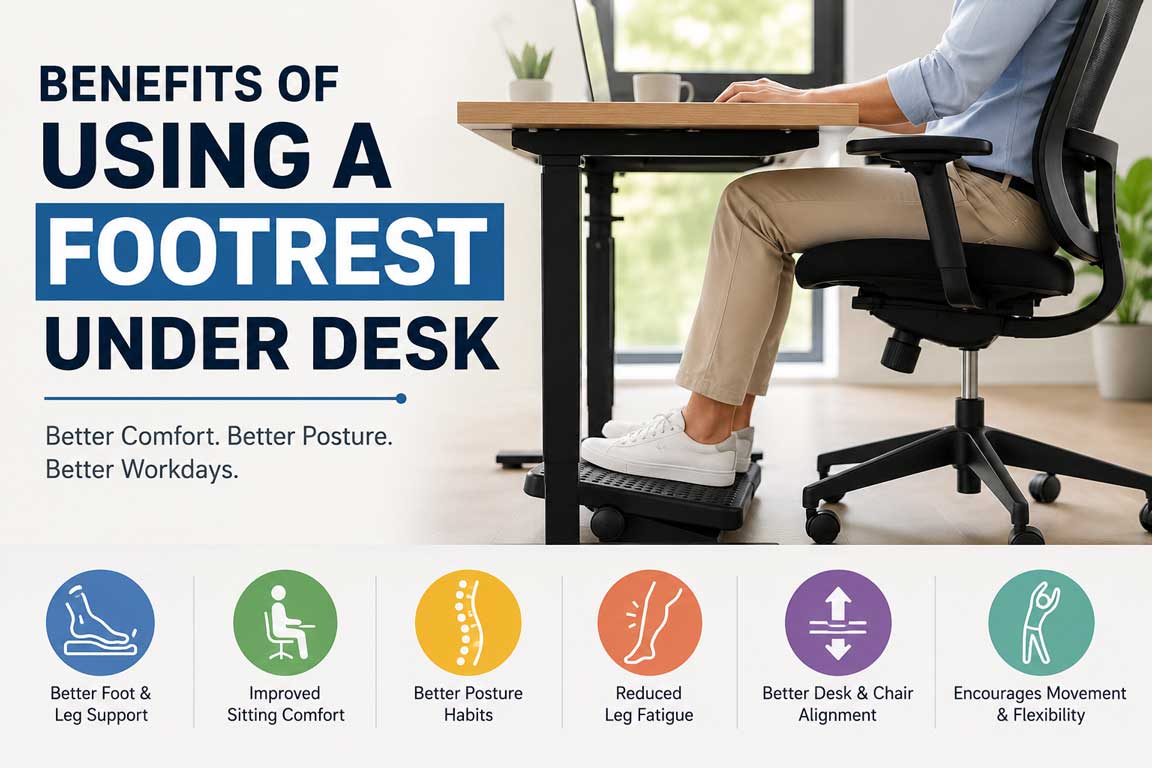
If you spend several hours a day sitting at a desk, you already know how quickly discomfort can build up. One thing many people overlook is where their feet actually rest during those long sessions. When your feet are left hanging or pressing awkwardly against the floor, the rest of your body tends to shift to compensate. A footrest is a simple tool that addresses this issue. In this guide, we break down the key benefits of using a footrest under desk and how it can make your workspace feel noticeably more comfortable.
Quick Answer
Using a footrest under your desk gives your feet a stable, supported surface while you sit. This can reduce leg fatigue, help you maintain a more natural sitting position, and make long work or study sessions feel less tiring. It is especially useful for people whose feet do not comfortably reach the floor at their current chair height.
Why Foot Support Matters When Sitting at a Desk
Most people focus on their chair, monitor height, or keyboard position when setting up a workspace. The feet, however, are just as important.
When your feet hang in the air or rest at an awkward angle, your legs have no stable base. Over time, this puts extra pressure on the backs of your thighs, restricts circulation, and causes your hips and lower back to shift position without you realizing it. The result is usually a gradual sense of heaviness or stiffness that gets worse as the hours pass.
A footrest gives your feet a proper landing place. With your feet supported, your legs can rest at a more natural angle, and your whole lower body tends to feel more settled and relaxed. It is a small change, but the difference during a long sitting session can be significant.
Key Benefits of Using a Footrest Under Desk
Better Foot and Leg Support
The most straightforward benefit of a footrest is exactly what the name suggests – it supports your feet. Instead of leaving them to dangle or press flat against a hard floor at the wrong angle, a footrest gives them a stable, cushioned surface.
This matters more than it sounds. Your legs make up a large part of your body weight, and when they have nowhere solid to rest, your muscles have to work quietly in the background to keep them in place. A footrest removes that strain. Your feet simply rest, and your legs follow.
For people who use higher desks or chairs — or anyone whose legs are on the shorter side – this kind of support can make a noticeable difference in how comfortable they feel by the end of the day.
Improved Sitting Comfort
A properly positioned footrest under desk can make long work sessions feel much more balanced and comfortable.
Comfort during long sitting hours depends on many small factors working together. Foot support is one of them.
When your feet are properly rested, you are less likely to fidget, cross your legs repeatedly, or slump forward to get more comfortable. You stay in a more settled position for longer, which means fewer interruptions and less general restlessness.
Many people who add a footrest to their setup report that their chair simply feels better – not because the chair changed, but because the full seating experience is now more balanced. The footrest handles the lower half of the equation.
Better Sitting Posture Habits
Posture is influenced by many factors – your chair, your monitor height, your desk setup, and yes, where your feet are. When your feet have nowhere stable to land, your hips tend to tilt, your back curves slightly, and your shoulders follow.
A footrest helps keep your hips in a more neutral position by giving your lower body something to push against gently. This can naturally encourage a more upright sitting angle over time. It is not a posture fix on its own, but as part of a well-adjusted workspace, it supports better sitting habits without you having to think about it constantly.
If you are also exploring options for ergonomic setup, our What Is an Ergonomic Foot Rest? guide explains the full concept in simple terms.
Reduced Leg Fatigue
Many people notice less lower-body tension after adding a footrest under desk to their workspace.
Sitting for long periods with unsupported legs is more tiring than most people realize. The muscles in your legs, calves, and feet are doing quiet work the entire time – trying to hold your limbs at a workable angle when there is no surface beneath them.
A footrest takes over that job. Your legs can fully relax, circulation stays steadier, and the buildup of tiredness and heaviness tends to slow down. By the time your workday or study session ends, your legs are less likely to feel stiff or worn out.
This is particularly noticeable for people who sit for four or more hours in a row.
More Comfortable Chair and Desk Alignment
Here is a practical scenario that comes up often: you raise your chair to a good height for your desk and keyboard, only to find that your feet no longer reach the floor comfortably. Lowering the chair fixes the feet problem but creates issues with your desk height, arm position, and monitor angle.
A footrest solves this directly. You keep your chair and desk at the right height for your arms and upper body, and the footrest fills the gap for your feet. This is one of the most practical under desk footrest benefits for people who work at fixed-height desks or use office chairs without full adjustability.
Our Adjustable Foot Rest Buying Guide covers what to look for when choosing the right footrest for your specific setup.
Gentle Movement and Flexibility
Staying completely still while sitting is actually harder on the body than moving occasionally. Some footrests are designed with a rocking or tilting surface that lets you shift your feet position slightly while you work.
This gentle movement keeps your leg muscles lightly active, helps maintain circulation, and breaks up the stiffness that comes from sitting in one fixed position for too long. It is not exercise — it is just small, natural movement that your body appreciates during long sessions.
If you find yourself feeling restless at your desk, a footrest with some tilt or rock to it can be a good option to consider.
Who Benefits Most from an Under Desk Footrest?
While anyone who sits at a desk can benefit from a footrest, some groups tend to notice the biggest difference:
Shorter users — If your feet naturally sit above the floor when your chair is at desk height, a footrest is not optional — it is essential for proper comfort.
Office workers — People who sit at a desk for six to eight hours a day have more to gain from foot support simply because the hours add up quickly.
Remote workers and home office users — Home setups are often less ergonomically dialed-in than professional offices, and a footrest is an affordable way to improve comfort without a full desk overhaul.
Students — Long study sessions on a chair that does not quite fit can be rough on the legs. A footrest makes those hours easier to manage.
People using high counters or standing desks in seated mode — When the work surface is higher than average, a footrest becomes critical.
Anyone recovering from leg or foot discomfort — While a footrest is not a medical device, having a proper surface for your feet during rest is generally more comfortable than leaving them unsupported.
Under Desk Footrest vs No Footrest
The difference between sitting with and without foot support comes down to how your whole lower body feels over time.
Without a footrest, your feet press awkwardly against the floor (or hang in the air), your thigh muscles quietly work to keep your legs up, and your sitting position gradually drifts as your body searches for comfort. By mid-afternoon, your legs may feel heavy, your back may ache from shifting positions, and your focus suffers as discomfort builds.
With a footrest, your feet have a proper base. Your legs rest fully. Your hips stay more level. Your chair feels better simply because you are sitting in it the way it was meant to be used. The same desk, the same chair – but a noticeably different experience.
It is one of those small workspace upgrades that feels almost too simple, until you try it and realize how much difference it actually makes.
Are Footrests Good for Posture?
The short answer is: they can support better posture as part of a complete ergonomic setup, but they are not a standalone fix.
Good sitting posture depends on several things working together – your chair height, your monitor position, your keyboard angle, your desk height, and yes, your foot support. When all of those elements are reasonably dialed in, a footrest fills the last piece of the puzzle for your lower body.
If your chair, desk, and monitor are set up poorly, a footrest alone will not correct the full picture. But for someone with a reasonably well-set-up workspace, adding a footrest can be the difference between sitting comfortably for two hours and sitting comfortably for six.
According to workplace ergonomics guidance from sources like OSHA’s ergonomics resources, supporting the full body during seated work — including the feet — is an important part of a comfortable and sustainable work setup.
When You May Not Need a Footrest
Not everyone needs a footrest, and there is no reason to add one to your setup if it solves a problem you do not have.
If your feet rest flat and comfortably on the floor when your chair is at the right height for your desk, you probably do not need one. Your feet already have a stable, natural surface. Adding a footrest in this case might actually change your position in a less comfortable direction.
The key question is simple: when you sit at your desk with your chair adjusted properly for your arms and upper body, where do your feet land? If they are flat and relaxed, you are already covered. If they are hovering, pressing awkwardly, or resting only on your toes, a footrest is worth trying.
How to Get the Most Benefit from a Footrest
Using a footrest properly makes a bigger difference than simply placing one under your desk and forgetting about it. Here are some practical tips:
Adjust your chair height first. Set your chair to a height that works well for your desk and keyboard. Then use the footrest to bring your feet up to a comfortable, flat position. Never adjust the footrest first and then try to work around your chair.
Keep your whole foot supported. Your entire foot – heel to toe – should rest on the footrest surface. Placing only your toes on it while your heels hang off creates an awkward angle that defeats the purpose.
Use a stable footrest. A footrest that slides around while you work is more distracting than helpful. Look for one with a non-slip base, or place it against something stable.
Combine it with good desk and monitor positioning. A footrest works best as part of a complete ergonomic setup. If your monitor is too low or your keyboard is awkwardly placed, foot support alone will not solve everything.
Adjust the height or angle if possible. If your footrest is adjustable, take a few minutes to find the angle that lets your feet rest naturally. A slight tilt is often more comfortable than a flat horizontal surface.
Of course, getting these benefits also depends on choosing a footrest that matches your height, desk setup, and daily work routine. If you’re still comparing different options, our guide to the best under desk foot rest explains which features matter most and how to choose the right one for your workspace.
Frequently Asked Questions
What are the main benefits of using a footrest under desk?
A footrest gives your feet a stable surface when they cannot comfortably reach the floor from your chair. The main benefits include better foot and leg support, reduced leg fatigue during long sitting sessions, improved sitting comfort, and a more balanced overall seating position. It is especially useful when your chair is raised to match your desk height but your feet no longer sit flat on the floor.
Does a footrest help with sitting posture?
A footrest can support better sitting habits as part of a well-configured workspace. When your feet have a stable surface, your hips tend to stay more level, which can encourage a more natural upright position. However, a footrest works best alongside other ergonomic adjustments – chair height, monitor level, and keyboard placement – rather than as a standalone posture solution.
Should your feet be flat on a footrest?
Yes, ideally your whole foot should rest comfortably on the footrest surface, with your heel and the ball of your foot both making contact. Resting only on your toes or only your heels creates an awkward leg angle and reduces the comfort benefit. If your footrest is height-adjustable, experiment with different settings until your feet feel fully and naturally supported.
Is an under desk footrest good for long sitting hours?
Yes, it can make a noticeable difference during longer sessions. When your feet are unsupported for several hours, leg fatigue tends to build up gradually and your sitting position shifts as your body searches for comfort. A footrest reduces that fatigue by giving your legs a stable resting surface, which helps you stay more comfortable and focused for longer.
Who should use an under desk footrest?
Anyone whose feet do not comfortably reach the floor at their working chair height will benefit most. This includes shorter users, people working at fixed-height desks, students, and remote workers with non-ideal home office setups. Office workers who sit for long hours and people who use high chairs or elevated desks also tend to see a clear improvement with foot support.
Final Thoughts
For people who sit for long hours, a footrest under desk is a simple upgrade that can improve daily comfort noticeably.
A footrest is one of the simplest additions you can make to a desk setup – and often one of the most overlooked. It does not require a complicated installation or a major investment. You place it under your desk, adjust it to suit your needs, and let it do its job quietly while you work or study.
The desk footrest benefits are practical and real: better foot and leg support, reduced tiredness during long sitting hours, a more stable sitting position, and an overall sense that your workspace actually fits your body. For anyone whose feet do not reach the floor comfortably, or who sits for extended periods and wants to feel less worn out by the end of the day, an under desk footrest is genuinely worth considering. It is not a cure for anything, and it works best as part of a thoughtfully set-up workspace. But as one piece of the ergonomic puzzle, it earns its place on the floor beneath your desk.