
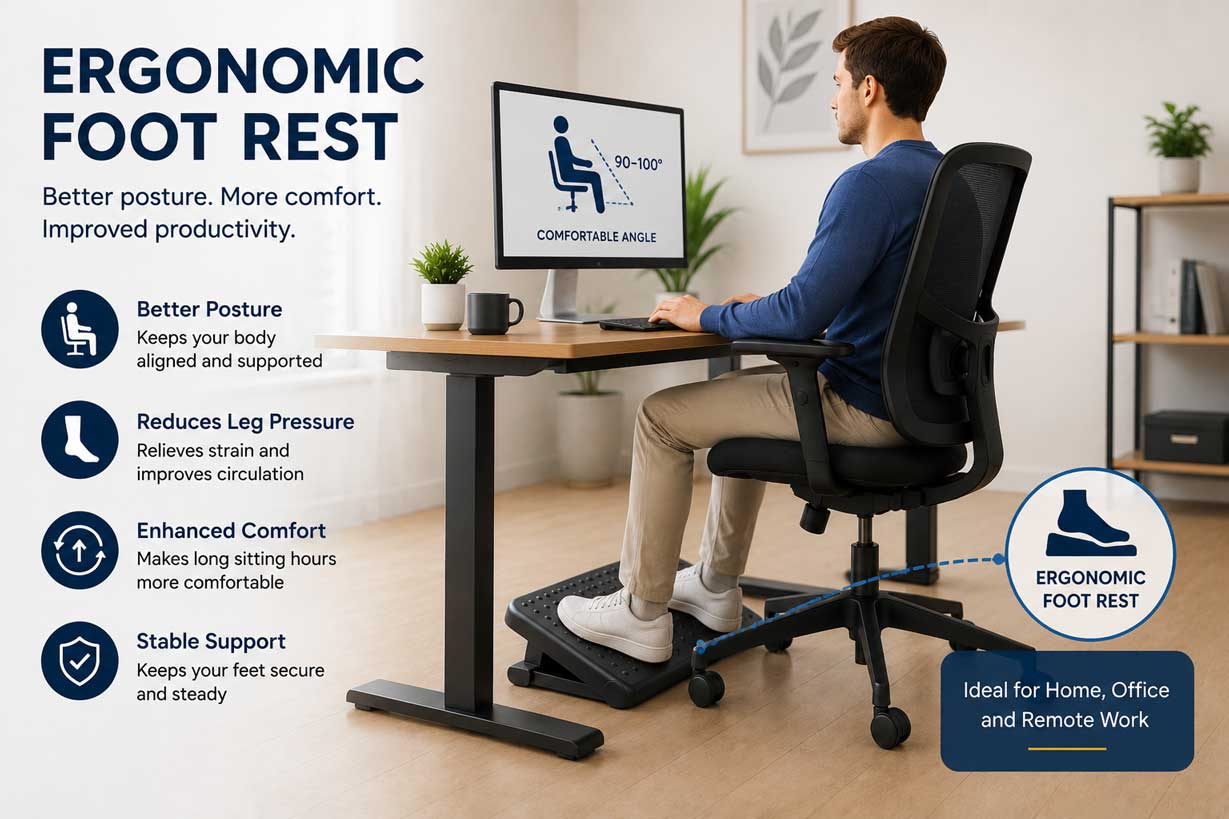
An ergonomic foot rest is designed to solve this problem by supporting your feet and improving desk comfort during long sitting hours. Many desk workers experience leg fatigue, foot numbness, or postural strain simply because their feet don’t have anywhere to rest properly. This becomes even more noticeable when your desk height, chair height, or leg length don’t align perfectly. The good news is that a simple desk accessory can make a real difference. An ergonomic foot rest is designed to solve this problem by providing proper foot support while you work. This article explains what one is, how it works, and whether it’s the right addition to your workspace.
Quick Answer
An ergonomic foot rest is a desk accessory that sits on the floor beneath your desk and supports your feet while you sit. Unlike a basic foot stool, it’s built to adjust to different body types and sitting heights, helping you maintain better posture and reduce leg fatigue during long hours at your desk.
What Does an Ergonomic Foot Rest Do?
The main job of an ergonomic foot rest is straightforward: it gives your feet a comfortable place to rest while you work. But there’s more to it than just that.
When you sit for hours without proper foot support, your legs and feet hang freely. This forces your leg muscles to work constantly just to keep your feet in place or to prevent them from swinging. Over time, this creates tension and fatigue in your legs and lower back.
A foot rest changes this dynamic. By providing a solid surface for your feet to rest on, it allows your leg muscles to relax. Your feet stay supported at a comfortable angle, which takes pressure off your lower legs and thighs. Many foot rests also have adjustable angles, which means you can position your feet in a way that feels most natural to your body.
When your feet are properly supported, something else improves too: your overall sitting posture. When your legs and feet are comfortable, you’re less likely to shift around constantly or slouch in your chair. This means better alignment for your spine and less strain on your neck and shoulders.
Why Ergonomic Footrests Matter for Desk Comfort?
Not everyone’s desk and chair combination matches their body size. A tall person might have a chair that’s too low relative to the desk. A shorter person might find their feet dangling above the floor even with the chair adjusted. Either way, unsupported feet lead to discomfort.
Long sitting hours make this problem worse. If you’re sitting for 8 hours or more, even minor discomfort becomes major pain by the end of the day. Your legs can feel stiff, your feet might tingle, and your lower back aches from the strain of keeping your body aligned without proper support.
This is why desk height, chair height, and leg support all matter for comfort. Your workspace should support your entire body-from your head down to your feet. When one element is missing (like foot support), the whole system becomes less comfortable, and you end up compensating with bad posture.
An ergonomic foot rest fills this gap. It’s a small addition that can prevent the discomfort that comes from sitting in a poorly supported position all day. For broader sitting posture guidance, Mayo Clinic also recommends keeping your feet supported and your knees at a comfortable angle while sitting.
Who Should Use an Ergonomic Foot Rest?
Certain groups of people benefit most from using a foot rest:
Office workers who sit at a desk all day are prime candidates. Many office setups don’t account for individual body sizes, so a foot rest helps bridge that gap.
Remote workers and home office users can customize their setup more easily, and adding a foot rest is a simple way to improve comfort in a home office space.
Students who spend hours studying or attending virtual classes often have the same issue: their feet don’t reach the ground comfortably in standard school or home setups.
Shorter individuals typically find foot rests most helpful because many standard desks and chairs are built for average or taller heights.
People with higher desks or chairs need foot support more than anyone. If your chair sits high relative to your body, your feet may not touch the ground, and a foot rest becomes essential.Anyone who sits for long hours experiences the benefits. Whether you’re in an office, at home, or a student, long sitting hours make foot support matter.
Common Features of Ergonomic Footrests
Not all foot rests are the same. Here are the features that make a foot rest truly ergonomic:
Adjustable Height
Different people are different heights, and desks come in different sizes. A foot rest with adjustable height lets you set it to the right level for your body and workspace. This is what separates an ergonomic foot rest from a basic stool-the ability to customize it for your specific needs. You can also explore our adjustable foot rest buying guide for more detailed recommendations.
Tilt Function
Some foot rests allow the surface to tilt at an angle. This feature lets your feet rest at a natural angle instead of flat. A slight tilt can reduce strain on your ankles and calves and help your feet feel more comfortable during long sitting periods.
Non-Slip Surface
A foot rest needs to stay in place and keep your feet stable. A textured or rubberized surface prevents your feet from sliding around, which is both a safety feature and a comfort feature. You won’t be adjusting it constantly, and your feet won’t slip when you move.
Rocking Motion
Some ergonomic foot rests have a gentle rocking feature. Instead of a static platform, you can rock slightly back and forth. This small movement keeps your legs engaged and can reduce stiffness during long sitting sessions.
Portable Design
If you move between rooms, work in different locations, or travel frequently, a lightweight, portable foot rest makes sense. Some are compact and easy to carry, while others are designed to stay permanently under a desk.
Ergonomic Foot Rest vs Regular Foot Stool
What’s the difference between an ergonomic foot rest and a basic foot stool? Both provide a place for your feet to rest, but ergonomic foot rests are built with desk use in mind.
A regular foot stool is typically fixed-one size, one height, one angle. It might be useful for general relaxation or watching TV, but it doesn’t adapt to your desk setup or body type.
An ergonomic foot rest is adjustable and designed for the specific demands of desk work. You can change the height, angle, and position to match your desk, chair, and body. Many have features like rocking motion or non-slip surfaces that are specifically useful for active sitting at a desk.
The bigger difference is intention. A foot stool is a generic item; an ergonomic foot rest is designed with desk comfort and posture in mind.
Benefits of Using an Ergonomic Foot Rest
Here are the practical benefits you can expect from using an ergonomic foot rest:
Better foot support. Your feet have a proper resting place instead of hanging or swinging. This is the most immediate benefit.
Improved sitting comfort. When your feet are comfortable, your whole body feels better. You can focus on work instead of fidgeting or shifting around constantly.
Reduced leg fatigue. When your leg muscles don’t have to work to hold your feet in place, they can relax. By the end of the day, your legs feel less tired.
Better sitting habits. When you’re comfortable, you’re more likely to maintain good posture. A foot rest encourages better alignment without forcing it.
Improved workspace ergonomics. A foot rest is part of a complete ergonomic setup. Combined with a good chair, desk, and monitor position, it contributes to overall comfort and productivity.
Reduced fidgeting. Many people fidget or shift constantly when sitting. Proper foot support reduces the urge to move around unnecessarily, which can help you focus.
These benefits are about comfort and habit formation, not about fixing medical problems. A foot rest is a practical tool that makes sitting more comfortable.
A quality ergonomic foot rest can make daily desk work noticeably more comfortable.
How to Choose the Right Ergonomic Foot Rest
Choosing a foot rest depends on your specific situation. Here’s what to consider:
Desk height. Measure the distance from your floor to the underside of your desk. Your foot rest needs to fit in that space and support your feet at a comfortable height. If your desk is higher, you’ll need a taller foot rest. If it’s lower, a shorter one works.
Even after narrowing down the features you need, choosing the right model can still feel overwhelming because different footrests are designed for different users and workspaces. If you’re comparing options, our guide to the best under desk foot rest explains what to look for and highlights the top choices for different comfort needs.
Chair height. Your chair height relative to your desk matters too. A chair that sits high might need a taller foot rest, while a lower chair might need something shorter.
Your body height. Taller people often need higher foot rests to achieve a comfortable angle. Shorter people might prefer lower ones. The goal is to have your legs at roughly a 90-degree angle or slightly more.
Adjustability. If you share your desk with someone else or like to change your setup, an adjustable foot rest gives you flexibility. Fixed-height rests are simpler but less adaptable.
Stability. A foot rest needs to feel solid and secure. It shouldn’t slide around when you place your feet on it or shift your weight.
Material. Some are plastic, some are wood, some have foam padding. Choose based on durability, comfort, and whether it fits your workspace aesthetically.
Home vs office use. Your home office might look different from your workplace. An office-bound foot rest can stay put, while a home one might need to be more portable.
Are Ergonomic Footrests Worth It?
This depends on your situation.
An ergonomic foot rest is worth it if:
- Your feet don’t reach the floor comfortably in your current setup
- You sit for 6+ hours a day
- You experience leg fatigue, foot numbness, or lower back discomfort
- Your desk and chair heights don’t match your body
An ergonomic foot rest might not be necessary if:
- Your current setup already allows your feet to rest flat on the floor at a 90-degree angle
- You only sit for short periods
- You already feel comfortable and don’t experience leg fatigue
The bottom line: a foot rest is an affordable, simple addition to your desk. If you suspect it might help, it’s worth trying. The risk is low, and if it improves your comfort, the benefit is real.
Frequently Asked Questions
Do ergonomic footrests help posture?
Indirectly, yes. A foot rest makes sitting more comfortable, which reduces the urge to slouch or shift constantly. When you’re comfortable, you naturally maintain better posture. However, a foot rest isn’t a posture-fixing device on its own-it works best as part of a complete ergonomic setup that includes a good chair, proper desk height, and monitor positioning.
Should your feet be flat while sitting?
Ideally, yes. When sitting at a desk, your feet should be flat on a surface (the floor or a foot rest), and your legs should form roughly a 90-degree angle at the knees. This position takes pressure off your legs and lower back. If your feet dangle or rest at an awkward angle, it creates tension and fatigue.
Are adjustable footrests better?
Adjustable foot rests offer more flexibility than fixed ones. If you share your workspace, want to try different heights, or need to adapt to different chair and desk combinations, adjustability is valuable. However, a well-chosen fixed-height foot rest can be just as effective if it matches your setup perfectly. It comes down to your personal needs and preference.
Can a footrest improve desk comfort?
Yes, a footrest can improve comfort for people whose feet don’t rest naturally on the floor. By providing proper foot support, it reduces leg fatigue and allows your legs to relax while sitting. This contributes to overall desk comfort, especially during long working hours.
Who benefits most from ergonomic footrests?
People who sit for extended periods and whose feet don’t rest comfortably on the floor benefit most. This includes office workers with standard desks, remote workers with non-adjustable setups, students, shorter individuals, and people with higher chairs or desks. Anyone experiencing leg fatigue or foot numbness from long sitting hours is a good candidate.
An ergonomic foot rest is especially useful for people who spend long hours working at a desk.
Final Thoughts
An ergonomic foot rest is a simple but practical desk accessory designed to support your feet and legs while you work. It’s not a medical device or a cure-all, but it is a smart addition to your workspace if your current setup leaves your feet unsupported.
When your feet are comfortable and properly supported, everything else follows: better sitting habits, reduced fatigue, improved focus, and a more comfortable workday. Combined with a good chair, proper desk height, and proper monitor positioning, a foot rest is part of the foundation of a comfortable, ergonomic workspace. If you spend hours sitting at a desk and your feet don’t reach the floor comfortably, an ergonomic foot rest is worth considering. It’s an affordable way to address a real comfort problem and support better sitting habits for the long term.
Choosing the right ergonomic foot rest depends on your desk setup, chair height, and personal comfort preferences.
1 thought on “What Is an Ergonomic Foot Rest?”